
After reciting the Hanukkah blessings and lighting the Menorah, Jewish families traditionally break into song. Among all the melodies associated with the holiday, none is more beloved or more widely sung than “Maoz Tzur” {מעוז צור}, often translated as “Rock of Ages.” This hymn has accompanied Hanukkah celebrations for centuries, weaving together history, faith, and the enduring resilience of the Jewish people.
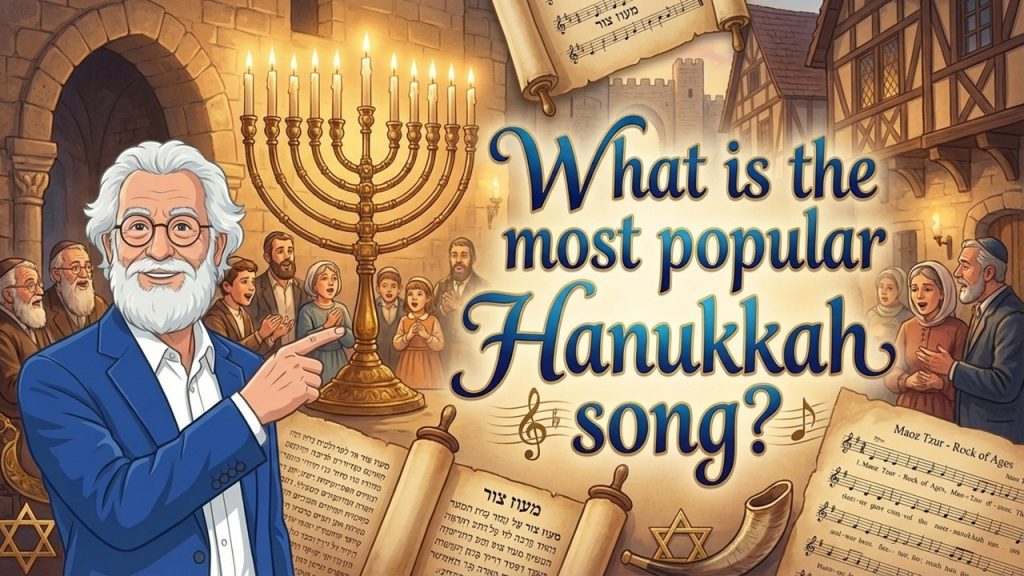
The poem itself was likely composed in 13th‑century Germany, during a period marked by both flourishing Jewish creativity and significant hardship. Its author remains unknown, though many scholars believe he encoded his name acrostically into the opening letters of the stanzas — a common poetic technique of the time. The melody we know today has its own fascinating journey. It appears to have been adopted in the 16th century from a popular folk tune associated with the early Protestant movement in Germany. Over time, Jewish communities embraced the melody, adapted it, and transformed it into the familiar Hanukkah song we know today.
“Maoz Tzur” is more than a festive tune; it is a poetic retelling of Jewish history. The hymn moves through the major moments of deliverance that shaped the Jewish story. It begins with the Exodus from Egypt, the foundational narrative of liberation. It then turns to the Babylonian exile, recalling the destruction of the First Temple and the longing for return. From there, it shifts to the story of the Book of Esther, celebrating the salvation of the Jewish people in Persia. Finally, the poem reaches the events of Hanukkah itself — the struggle of the Maccabees, the victory over the Seleucid Empire, and the rededication of the Temple.
By recounting these episodes, the song places Hanukkah within the broader arc of Jewish endurance. Each stanza echoes the same message: throughout history, the Jewish people have faced powerful adversaries, yet time and again they have found strength, hope, and renewal. Singing “Maoz Tzur” after lighting the Menorah becomes a way of connecting our own celebration to generations before us, joining their voices in gratitude and faith.
Even today, the melody fills homes and synagogues around the world, reminding us that Hanukkah is not only a story of ancient miracles but also a celebration of the enduring spirit of the Jewish people.