Pronouns in Hebrew are essential building blocks of speech. They reflect gender, number, and sometimes person, and they change depending on whether they’re used as subjects, objects, or possessives.
Personal Pronouns (Subject Form)
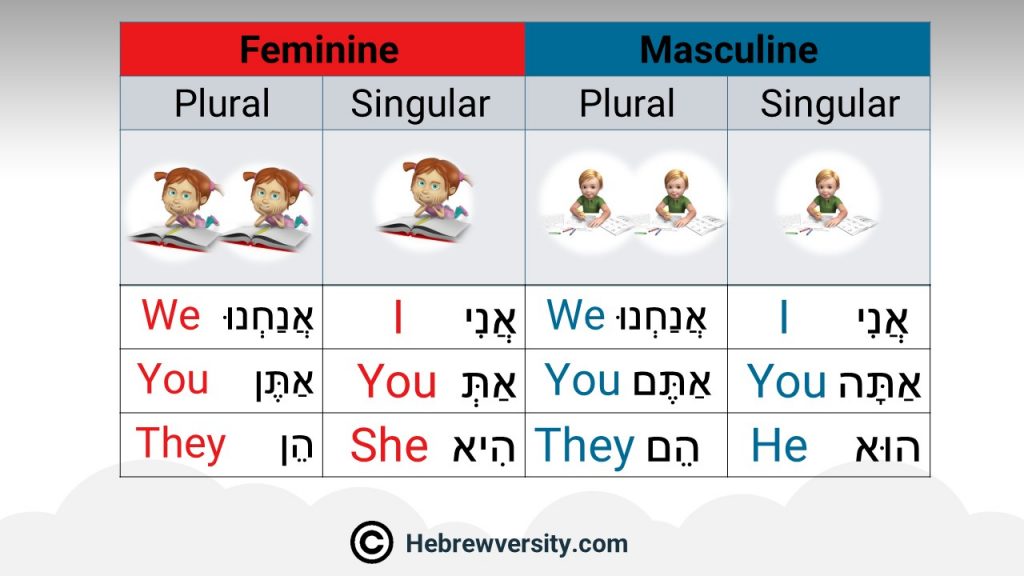
Hebrew personal pronouns vary by person, gender, and number:
|
Person |
Singular |
Plural |
|
First |
אני (ani) – I |
אנחנו (anachnu) – we |
|
Second (m.) |
אתה (atah) – you |
אתם (atem) – you (m.) |
|
Second (f.) |
את (at) – you |
אתן (aten) – you (f.) |
|
Third (m.) |
הוא (hu) – he |
הם (hem) – they (m.) |
|
Third (f.) |
היא (hi) – she |
הן (hen) – they (f.) |
Object Pronouns
These are often attached to verbs or prepositions. For example:
- אני אוהב אותך (ani ohev otach) – I love you (to a female)
- היא רואה אותו (hi ro’ah oto) – She sees him
Gender and Agreement
Just like nouns and verbs, pronouns in Hebrew must agree in gender and number with the rest of the sentence. This makes Hebrew a highly inflected language, where even short phrases carry rich grammatical information.
Pronouns in Biblical Hebrew
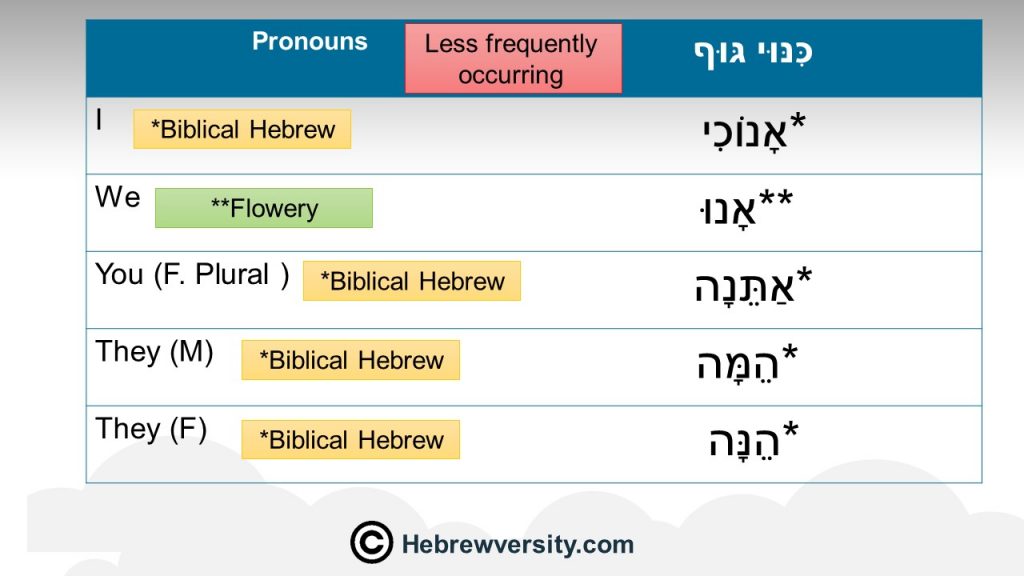
Biblical Hebrew uses a rich set of personal pronouns, many of which appear in multiple forms depending on style, emphasis, or poetic register. For the first person singular, both אֲנִי (ani) and אָנֹכִי (anokhi) mean “I,” with anokhi often used in elevated or divine speech. The first person plural also appears in two forms: אֲנַחְנוּ (anachnu) and the more formal or poetic אָנוּ (anu) – both meaning “we.” Second person feminine plural can be expressed as אַתֵּן (aten) or אַתֵּנָה (atena), while third person masculine plural appears as הֵם (hem) or the more literary הֵמָּה (hema). These variations are grammatically equivalent but reflect tone, context, and stylistic choice, especially in biblical narrative and poetry.