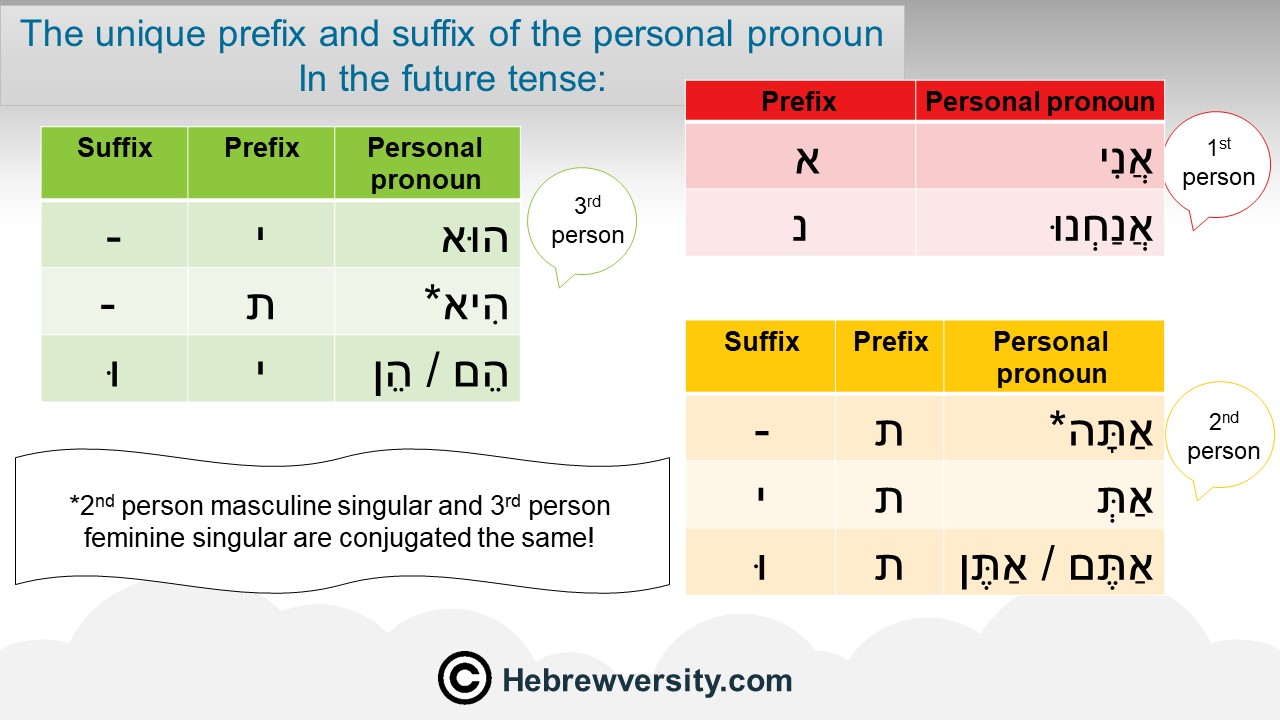
In Hebrew, the future tense (atid) is used to describe actions that will happen. Hebrew verbs in the future tense are fully conjugated to reflect the subject’s person, gender, and number, just like in the past tense – but with different prefixes.
Key Features
- Future tense verbs begin with a prefix that indicates the subject.
- The verb form changes depending on who will perform the action.
- There’s no need for auxiliary verbs like “will” or “shall” – the verb itself carries the future meaning.
Example: Root כ.ת.ב (k.t.v – related to writing)
| Person & Gender | Hebrew Form | Transliteration | Meaning |
| I (m./f.) | אכתוב | echtov | I will write |
| You (m. singular) | תכתוב | tichtov | You will write |
| You (f. singular) | תכתבי | tichtvi | You will write |
| He | יכתוב | yichtov | He will write |
| She | תכתוב | tichtov | She will write |
| We (m./f.) | נכתוב | nichtov | We will write |
| You (plural) | תכתבו | tichtvu | You will write |
| They (plural) | יכתבו | yichtvu | They will write |
Sentence Examples
- אני אכתוב מכתב מחר (ani echtov michtav machar) – I will write a letter tomorrow
- היא תכתוב את הסיפור (hi tichtov et ha-sipur) – She will write the story
- אנחנו נכתוב ביחד (anachnu nichtov beyachad) – We will write together
Did You Know? Feminine Plural Form Exists!
There’s a special future tense form in Hebrew that many learners don’t encounter right away:
תכתובנה (tichtovnah) – the feminine plural form for “you” or “they will write.”
This form is grammatically correct and appears in biblical, formal, and literary Hebrew.
However, in everyday modern speech, it’s almost never used. Instead, speakers typically use:
- תכתבו (tichtvu) – for “you” (plural, both genders)
- יכתבו (yichtvu) – for “they” (plural, both genders)
So if you spot תכתובנה in a poem, prayer, or ancient text – now you know what it means!