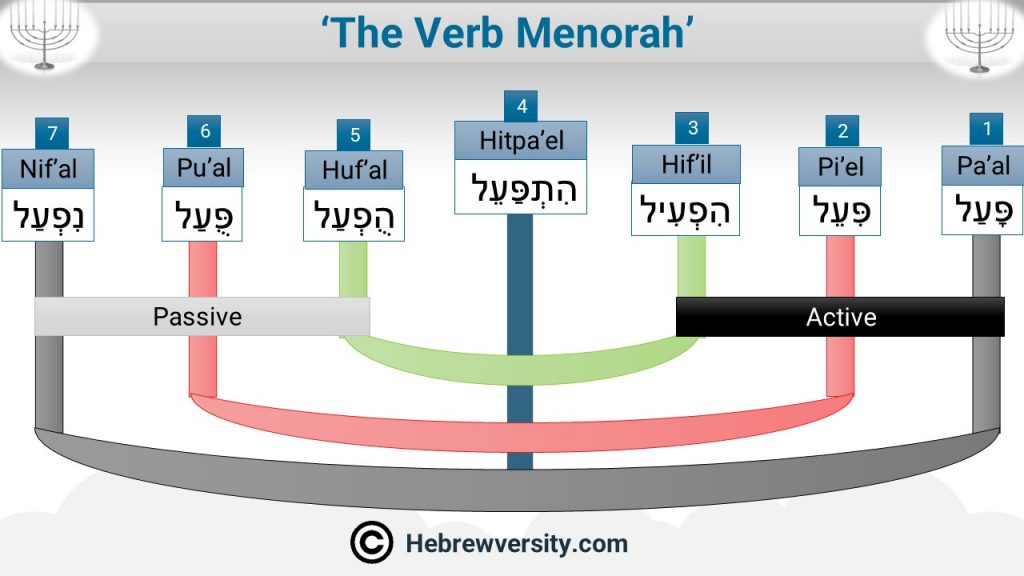
In Hebrew, verbs are not just words – they are structures. The term binyanim (בניינים), which literally means “buildings” or “structures,” refers to the patterns that shape Hebrew verbs. These patterns don’t just tell us how to conjugate a verb – they reveal how the action is performed, who performs it, and whether it’s active, passive, or reflexive.
What Is a Binyan?
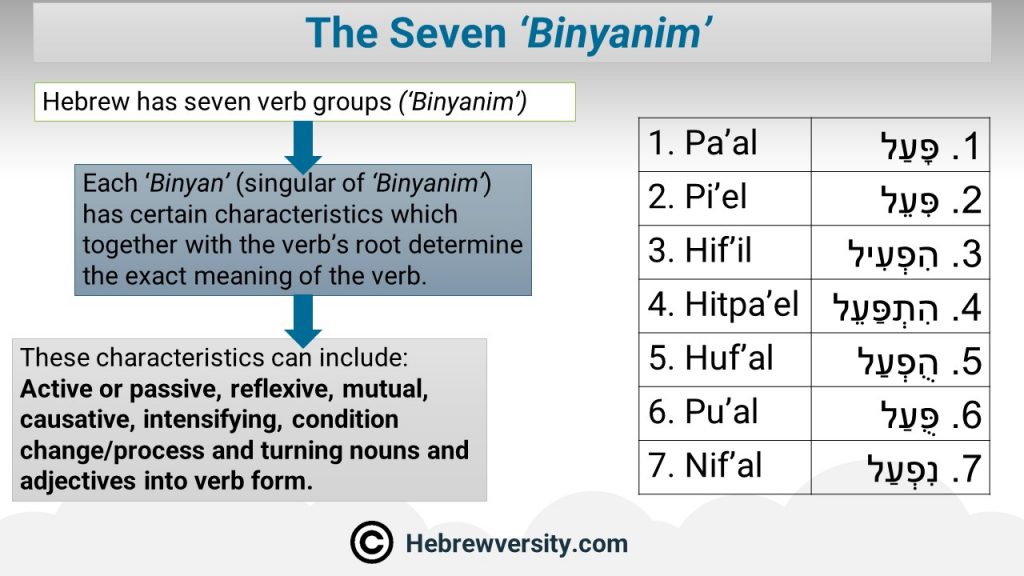
Each Hebrew verb is built from a root (shoresh) – usually three consonants that carry a core meaning. That root is then placed into one of seven binyanim, which act like grammatical “frames” that give the verb its voice and nuance.
For example, the root כ.ת.ב (k-t-v), related to writing, can appear in different binyanim:
- כתב (katav) – he wrote (simple active)
- נכתב (nikhtav) – it was written (passive)
- הכתיב (hikhtiv) – he dictated (causative)
- התכתב (hitkatev) – he corresponded (reflexive)
Each binyan adds a layer of meaning to the same root.
Why Binyanim Matter
Binyanim are more than just grammar – they reflect how Hebrew speakers conceptualize action. Instead of memorizing endless verb forms, learners can understand how meaning shifts through structure:
- Is the subject doing the action? (active)
- Is the subject receiving the action? (passive)
- Is the subject affecting themselves? (reflexive)
- Is the subject causing someone else to act? (causative)
This system makes Hebrew verbs logical and expressive, allowing speakers to convey subtle differences with precision.
A Language of Patterns
Learning binyanim is like learning the architecture of Hebrew. Once you understand the structure, you can unlock hundreds of verbs just by recognizing the root and the pattern.