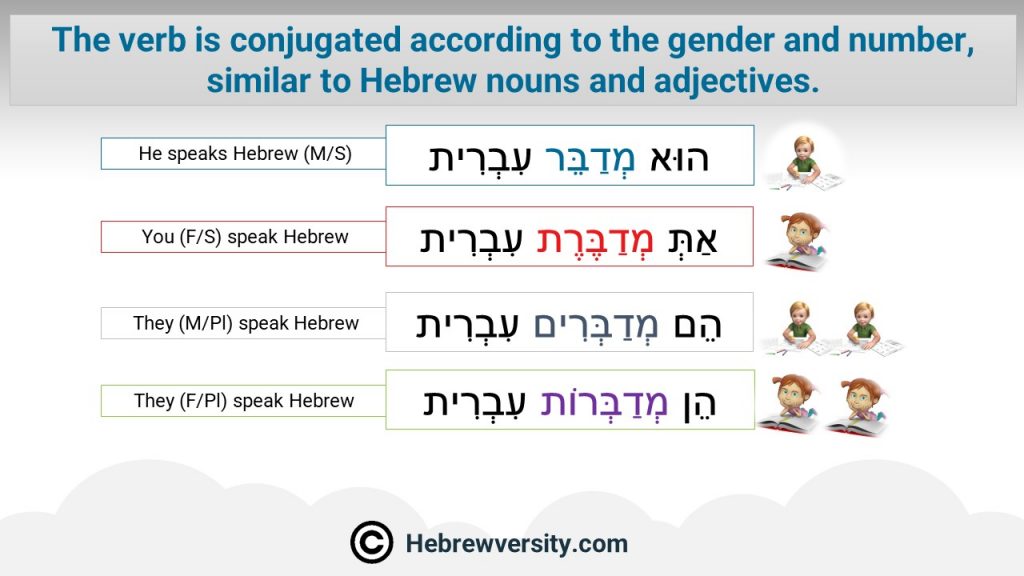
Pi’el is one of Hebrew’s most expressive verb patterns. It often conveys an intensive, repetitive, or causative action compared to its simpler counterpart, Pa’al.
How Pi’el Works in the Present Tense
Pi’el verbs in the present tense follow a consistent structure:
- Prefix: מְ (me-)
- Vowel Pattern: e-a-e (as in מְסַדֵּר – “organizes”)
- Middle Root Letter: Doubled (marked with a dagesh)
The base form is: מְפַעֵּל – using פ.ע.ל as a placeholder root.
Infinitive Form
The infinitive in Pi’el is usually formed with the pattern: לְפַעֵּל – with the לְ prefix and the same internal structure as the present tense.
Conjugation Table (Using ס.ד.ר – “to organize”)
| Person & Gender | Hebrew Form | Transliteration | English Meaning |
| Masculine Singular | מְסַדֵּר | mesader | He organizes |
| Feminine Singular | מְסַדֶּרֶת | mesaderet | She organizes |
| Masculine Plural | מְסַדְּרִים | mesadrim | They (m) organize |
| Feminine Plural | מְסַדְּרוֹת | mesadrot | They (f) organize |
Infinitive: לְסַדֵּר (lesader)
Common Pi’el Verbs in Present Tense
| Verb (Present) | Transliteration | Infinitive | Meaning |
| מְסַדֵּר | mesader | לְסַדֵּר | organizes |
| מְקַבֵּל | mekabel | לְקַבֵּל | receives |
| מְחַבֵּר | mechaber | לְחַבֵּר | connects / composes |
| מְצַיֵּר | metzayer | לְצַיֵּר | draws / paints |
| מְבַשֵּׁל | mevashel | לְבַשֵּׁל | cooks |
Tip for Learners
If you see a verb with a doubled middle letter and the מְ prefix in present tense, chances are it’s Pi’el. These verbs often feel more “active” or “intentional” than their Pa’al counterparts. Start with regular roots to build a strong foundation before exploring exceptions.