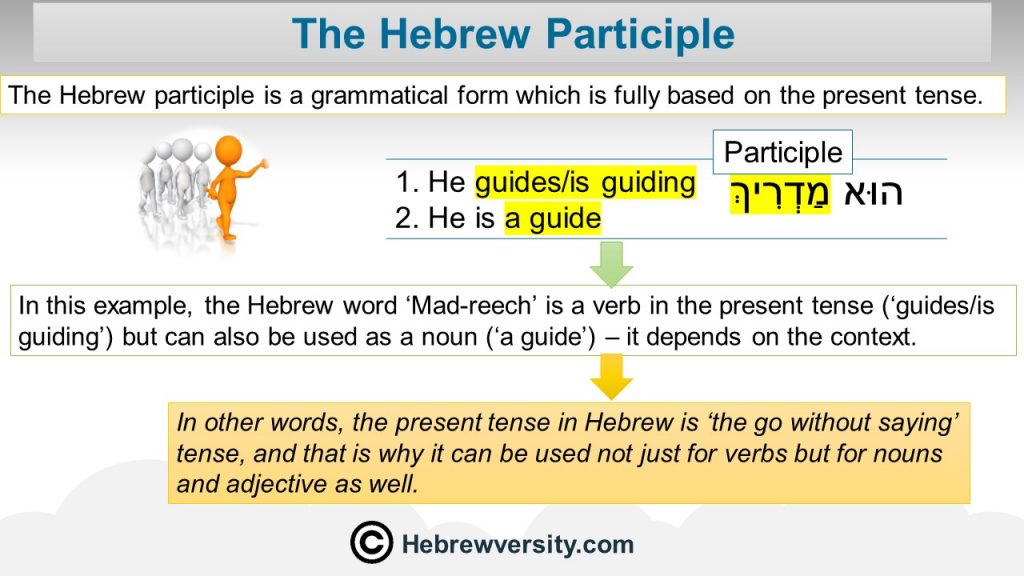
In Hebrew grammar, what linguists call a participle is essentially a noun or adjective that’s built from the present tense form of a verb. It describes someone or something performing an action – or being in a state – without functioning as a full verb in the sentence.
What Is a Participle in Hebrew?
The Hebrew participle is a verbal form that behaves like a noun or adjective. It’s based on the present tense of the verb and reflects:
- Gender (masculine/feminine)
- Number (singular/plural)
- Voice (active/passive)
It does not change for person (I, you, he, etc.), and it’s often used to describe roles, behaviors, or ongoing states.
How It Works
Hebrew participles are formed by taking the present tense verb and using it as:
- A noun: הכותב (ha-kotev) – “the writer”
- An adjective: ילד לומד (yeled lomed) – “a learning child”
Biblical and Modern Use
In Biblical Hebrew, participles are often used as titles or descriptors:
- הָרוֹעֶה (ha-ro’eh) – the shepherd
- הַשּׁוֹפֵט (ha-shofet) – the judge
In Modern Hebrew, they’re common in everyday speech and writing, especially in journalism, literature, and professional contexts.