
The verse that opens the story of the Tower of Babel carries a translation problem which almost every English reader walks straight past – “And the whole earth was of one language, and of one speech.” (Genesis 11:1 KJV)
In the original Hebrew the verse reads ‘safah achat u-devarim achadim’ {שפה אחת ודברים אחדים}, and that is literally “ONE lip and ONE words” – which means the Bible does not say that all mankind had one tongue but that they had one LIP.
The Hebrew word for ‘language’ here is ‘safah’ {שפה}, which also means a lip, the physical lip, and by extension the edge or the border of anything.
Now the word which is absent is just as important, because Hebrew has a SECOND word for language – ‘lashon’ {לשון} – which means the tongue, the organ inside the mouth, and which appears whenever the Bible speaks of a heavy tongue or of the speech of a distant province.
Yes, this is what happens in the Book of Esther, where the royal decree goes out to every province “according to the language of every people” and the original Hebrew there is ‘ki-lshon amo’ {כלשון עמו}, with a tongue and not a lip.
The difference between the two words is the difference between what comes out and what it comes from – ‘safah’ is the surface, speech as it lands in another person’s ear, the shared thing which everyone understands, while ‘lashon’ is the muscle that makes it, the accent and the idiom and the intimate mother tongue which no one else quite has.
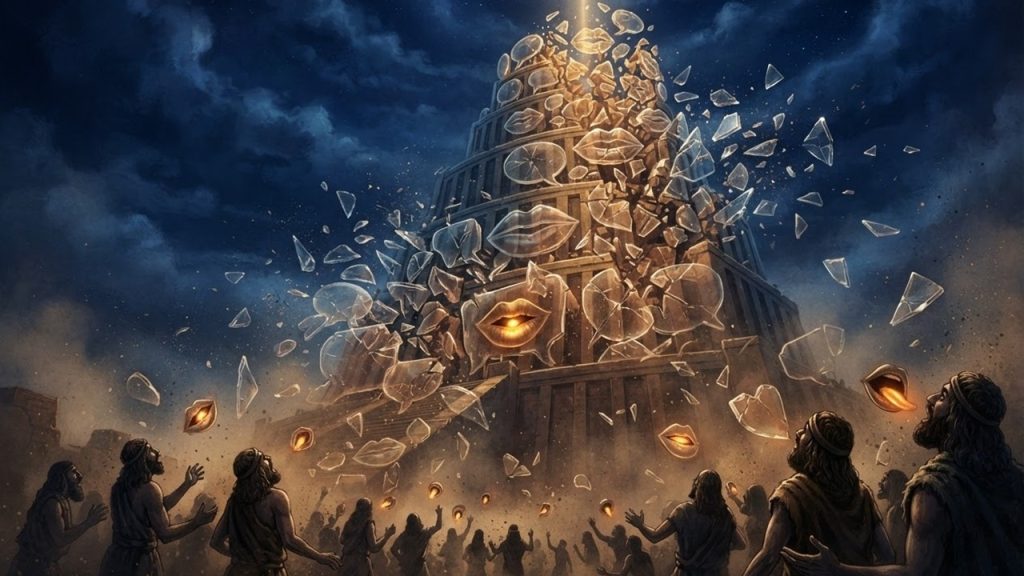
And now read what God actually does at Babel, because “Go to, let us go down, and there confound their language, that they may not understand one another’s speech” (Genesis 11:7) appears in the Hebrew as ‘navlah sham sfatam’ {נבלה שם שפתם} – “confounded there their LIP”.
The lip was confused and not the tongue, so the organ stayed exactly where it was, and that is the shock of the story – what broke at Babel was not the ability to speak but the ability to be understood, the shared surface, the border where one person’s words meet another person’s ear.
The name of the place carries the same mechanism, because ‘Bavel’ {בבל} is built on the Hebrew root ב-ל-ל which means ‘to mix’ and the verse says so itself – “because the LORD did there confound the language of all the earth.” (Genesis 11:9)
And that is why the prophecy of the repair uses the SAME word and not the other one: “For then will I turn to the people a pure language, that they may all call upon the name of the LORD, to serve him with one consent” (Zephaniah 3:9) – ‘safah berurah’ {שפה ברורה}, a clear LIP.
In Modern Hebrew both words are still alive and they still divide the same way – we say ‘safah zara’ {שפה זרה} for a foreign language and we say ‘lashon ha-ra’ {לשון הרע} for the evil tongue, and there is a reason why the sages never called it ‘safah ha-ra’.
Because the lip is what you share with others, and the tongue is what you are responsible for.
Babel broke the first, which is exactly why the second is still possible.
Key Takeaways
- The verse about the Tower of Babel highlights a translation problem in Genesis 11:1 regarding the terms for language used in Hebrew.
- The Hebrew word ‘safah’ means ‘lip’ and refers to shared speech, while ‘lashon’ means ‘tongue’ and represents individual speech.
- At Babel, God confused the ‘lip’ not the ‘tongue’, indicating the loss of mutual understanding rather than the ability to speak.
- The name ‘Babel’ comes from the root for ‘to mix’, emphasizing the mixing and confusion of shared language.
- Modern Hebrew still differentiates between ‘safah’ for surface language and ‘lashon’ for personal speech, reflecting this ancient distinction.