
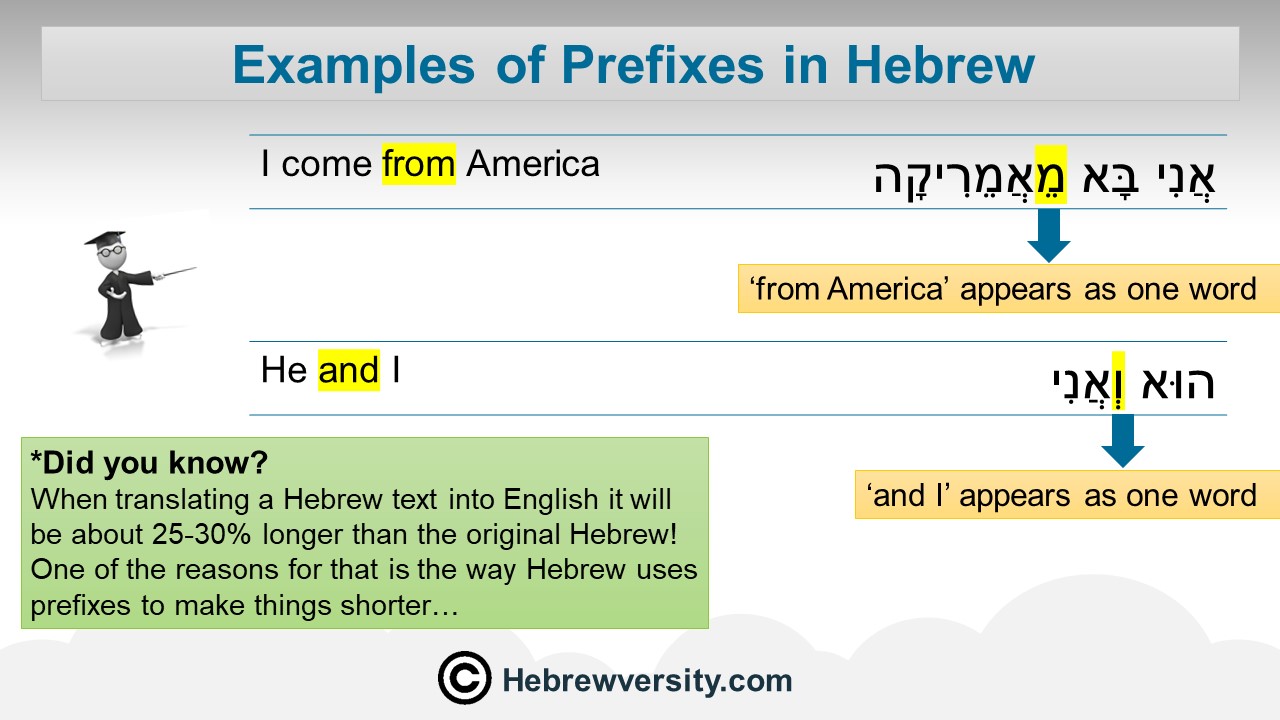
Hebrew uses a set of seven common prefixes – short letters added to the beginning of words to express grammatical relationships. These prefixes are so central to Hebrew that learners often remember them using the mnemonic phrase:
“משה וכלב” – Moshe and Caleb
Each letter in this phrase represents one of the seven most frequent Hebrew prefixes:
The Seven Hebrew Prefixes
| Letter | Function | Meaning | Example |
| מ־ | Preposition | from | מבית (mi-bayit) – from a house |
| ש־ | Relative pronoun | that / which | שאמרת (she-amarta) – that you said |
| ה־ | Definite article | the | הספר (ha-sefer) – the book |
| ו־ | Conjunction | and | ומוזיקה (u-muzikah) – and music |
| כ־ | Comparison | like / as | כמלך (ke-melech) – like a king |
| ל־ | Preposition | to / for | לבית (la-bayit) – to the house |
| ב־ | Preposition | in / with / at | בבית (ba-bayit) – in the house |
Why It Matters
These prefixes:
- Attach directly to nouns, verbs, and adjectives
- Often merge with the definite article ה־ (e.g., לבית = ל־ + הבית)
- Can change pronunciation depending on the first letter of the word
- Are essential for reading Hebrew fluently and understanding sentence structure