In Hebrew, numbers are closely connected to grammatical gender.
Every noun in Hebrew is either masculine or feminine, and the number that describes it must match that gender.
This rule applies to cardinal numbers (one, two, three…) and ordinal numbers (first, second, third…).
Cardinal Numbers – Masculine and Feminine Forms
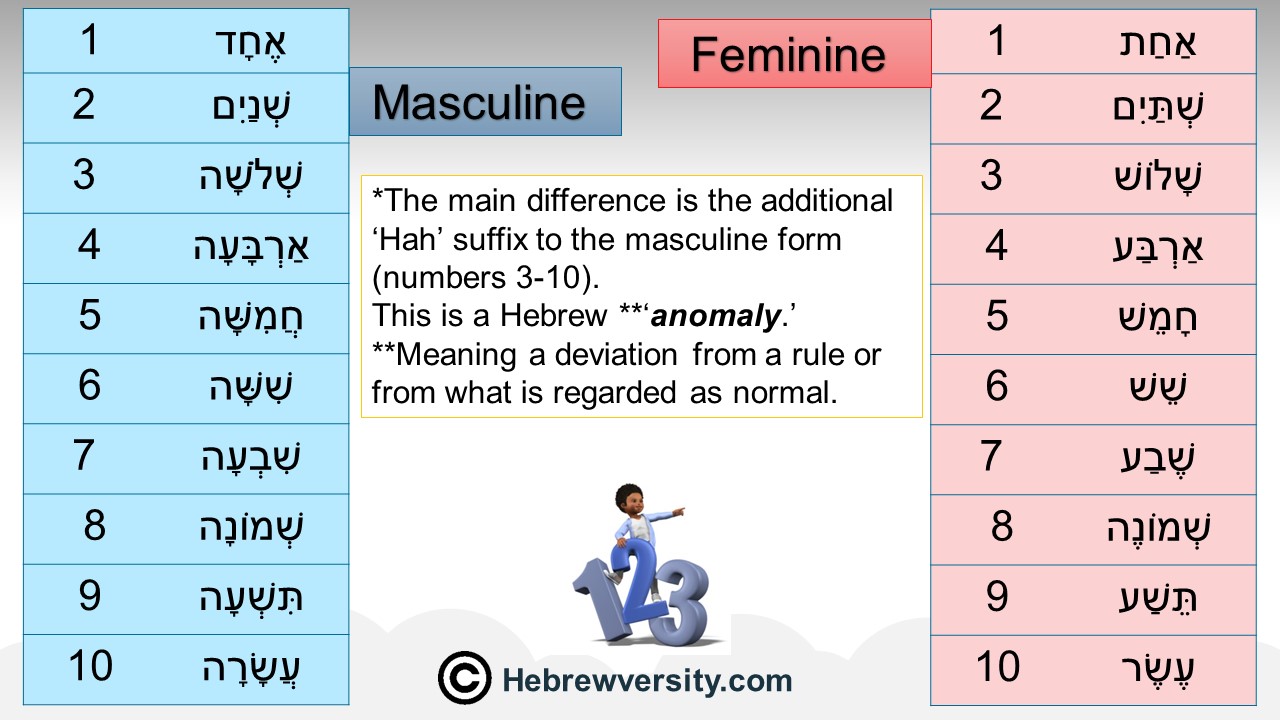
Hebrew cardinal numbers from 1 to 10 have two forms: masculine and feminine.
Examples:
- אֶחָד (echad) – one (masculine)
- אַחַת (achat) – one (feminine)
- שְׁנַיִם (shnayim) – two (masculine)
- שְׁתַּיִם (shtayim) – two (feminine)
From 3 to 10, the masculine forms often end with ה, and the feminine forms have no special ending.
This creates the illusion that the genders are “reversed,” but this is only a visual impression.
The real rule
The number always agrees with the noun it describes —
masculine number → masculine noun
feminine number → feminine noun
This is true in every position:
- before the noun
- after the noun
- in counting
- in describing quantities
There is no grammatical reversal.
Examples:
Masculine noun:
שְׁלוֹשָׁה סְפָרִים
shlosha sfarim
Three books
(“books” is masculine → number is masculine)
Feminine noun:
שָׁלוֹשׁ תְּמוּנוֹת
shalosh tmunot
Three pictures
(“pictures” is feminine → number is feminine)
Even though shlosha ends with ה and shalosh does not, the agreement is correct.
The confusion comes from the appearance of the forms, not from the grammar.
Ordinal Numbers – Order and Rank
Ordinal numbers also have masculine and feminine forms, but their pattern is simpler and more predictable.
Examples:
- רִאשׁוֹן (rishon) – first (masculine)
- רִאשׁוֹנָה (rishonah) – first (feminine)
- שֵׁנִי (sheni) – second (masculine)
- שְׁנִיָּה (shniyah) – second (feminine)
Ordinal numbers are commonly used from 1 to 10.
Beyond that, Hebrew often uses regular numbers with context.
Summary
- Hebrew numbers have masculine and feminine forms.
- The number always matches the gender of the noun it describes.
- The idea of a “reversal” is a misunderstanding caused by how the forms look, not how they function.
- Ordinal numbers follow a simple masculine/feminine pattern.