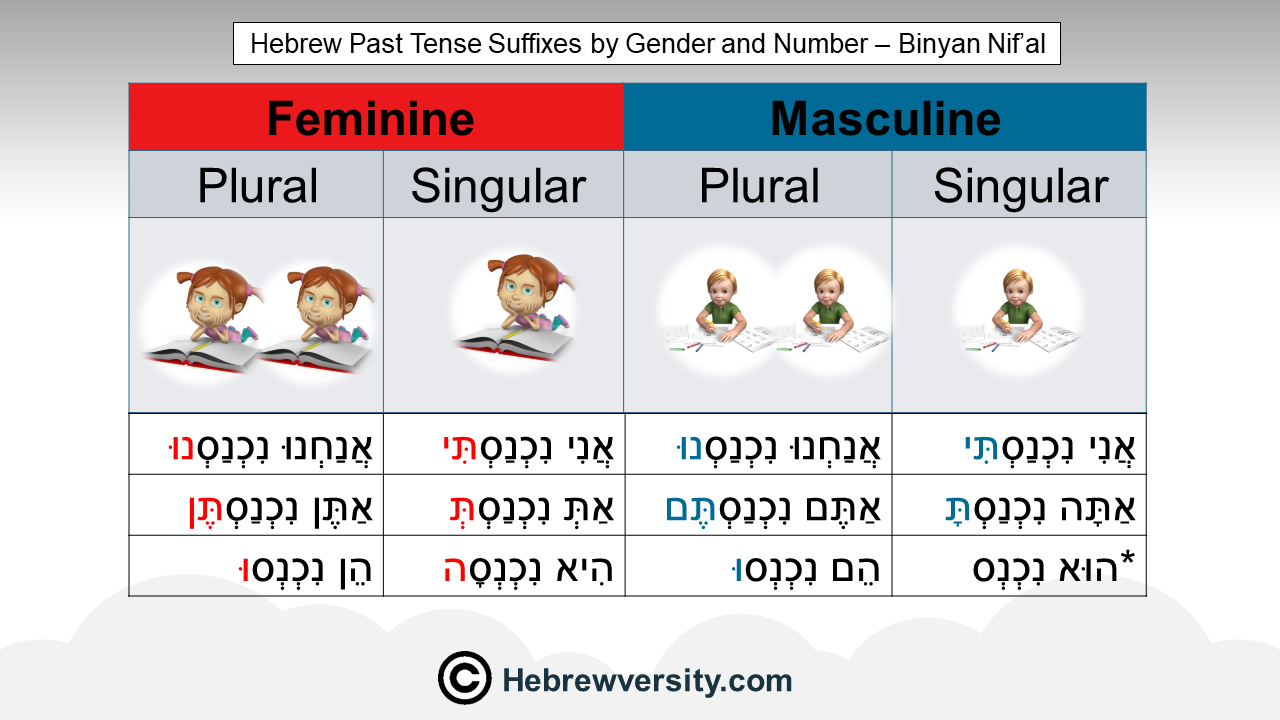
Nif’al is the passive counterpart of Pa’al. In the past tense, it describes actions that happened to the subject- either passively, reflexively, or spontaneously. These verbs often express being affected by something, entering a state, or undergoing a process.
Structure of Nif’al in Past Tense
- Prefix (נִ)
- Vowel Pattern: i-a or i-e depending on the form (as in נִכְנַס – “he entered”)
The base form is: נִפְעַל – using פ.ע.ל as the placeholder root
Conjugation Table (Using כ.נ.ס – “to enter”)
| Person & Gender | Hebrew Form | Transliteration | English Meaning |
| אני | נִכְנַסְתִּי | nikhnasti | I entered |
| אתה | נִכְנַסְתָּ | nikhnasta | You (m) entered |
| את | נִכְנַסְתְּ | nikhnast | You (f) entered |
| הוא | נִכְנַס | nikhnas | He entered |
| היא | נִכְנְסָה | nikhnesah | She entered |
| אנחנו | נִכְנַסְנוּ | nikhnasnu | We entered |
| אתם/אתן | נִכְנַסְתֶּם/ן | nikhnastem/nikhnasten | You (pl) entered |
| הם/הן | נִכְנְסוּ | nikhnesu | They entered |
Common Nif’al Verbs in Past Tense
| Verb (Past) | Transliteration | Meaning |
| נִכְנַס | nikhnas | entered |
| נִסְגַּר | nisgar | was closed |
| נִפְגַּשׁ | nifgash | met (was met) |
| נִשְׁמַר | nishmar | was guarded |
| נִלְמַד | nilmad | was learned |
Tip for Learners
Nif’al verbs in the past tense often describe what happened to the subject, rather than what the subject did. Look for the נִ prefix and the i-a vowel pattern. These verbs are common in both spoken and written Hebrew, especially when describing events or conditions.