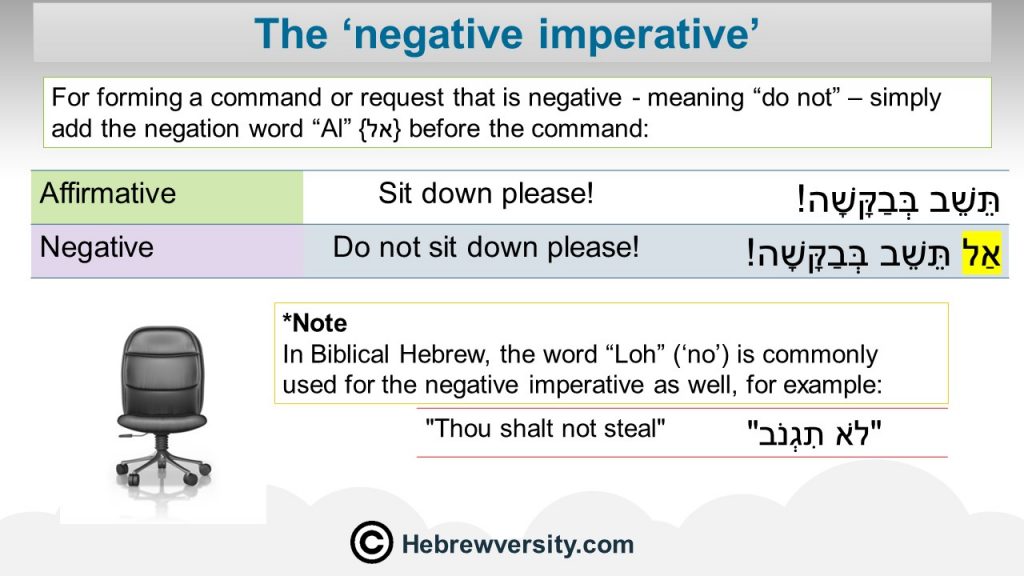
The imperative form in Hebrew is used to give commands, instructions, or requests – just like “Sit!”, “Write!”, or “Come!” in English. It’s direct, action-oriented, and always addressed to you (singular or plural).
Key Features
- Imperative verbs exist only in the second person (you).
- They are based on the future tense form, but with slight changes.
- There’s no need for pronouns – the verb itself implies the subject.
- Hebrew imperative forms vary by gender and number.
Example: Root כ.ת.ב (k.t.v – related to writing)
| Person & Gender | Hebrew Form | Transliteration | Meaning |
| You (m. singular) | כתוב | ktov | Write! |
| You (f. singular) | כתבי | kitvi | Write! |
| You (plural) | כתבו | kitvu | Write! |
Sentence Examples
- כתוב את שמך כאן (ktov et shimcha kan) – Write your name here
- כתבי לי מכתב (kitvi li michtav) – Write me a letter
- כתבו את התשובה ביחד (kitvu et ha-teshuvah beyachad) – Write the answer together
Negative Imperative
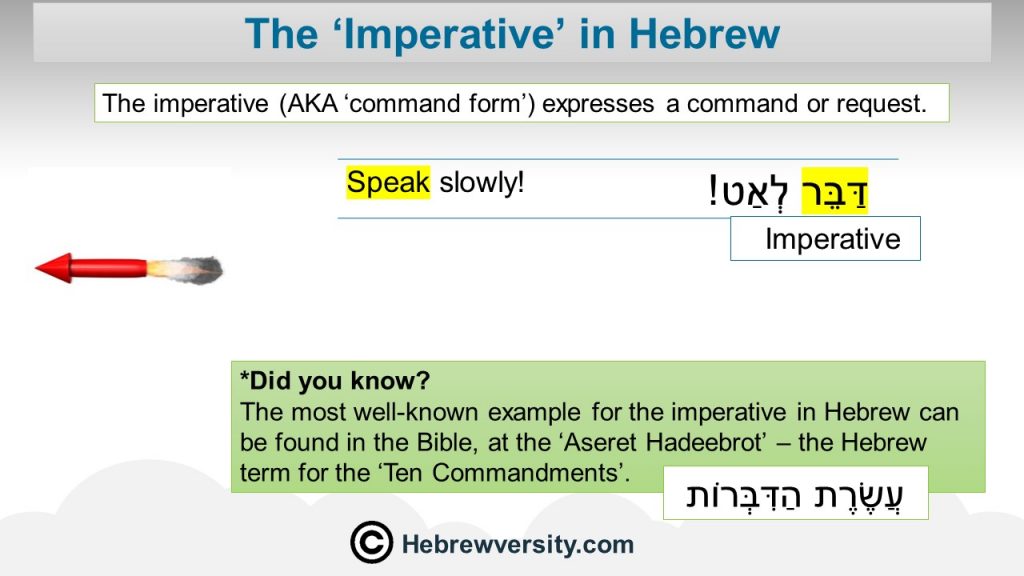
To say “don’t do something,” Hebrew uses the word אל (al) followed by the future tense form of the verb.
Examples:
- אל תכתוב (al tichtov) – Don’t write (m.)
- אל תכתבי (al tichtvi) – Don’t write (f.)
- אל תכתבו (al tichtvu) – Don’t write (plural)
Did You Know? Future Tense Can Be Used as Imperative
In modern Hebrew, it’s very common to use the second person future tense as a polite or indirect way to give instructions – especially in formal settings, signs, or written language.
Examples:
- תשב כאן בבקשה (teshev kan bevakashah) – Please sit here
- תכתבו את שמכם למטה (tichtvu et shimchem lematah) – Write your names below
- תביא לי מים (tavi li mayim) – Bring me water
This form is grammatically future, but functionally imperative. It’s especially useful when you want to sound respectful or less direct.