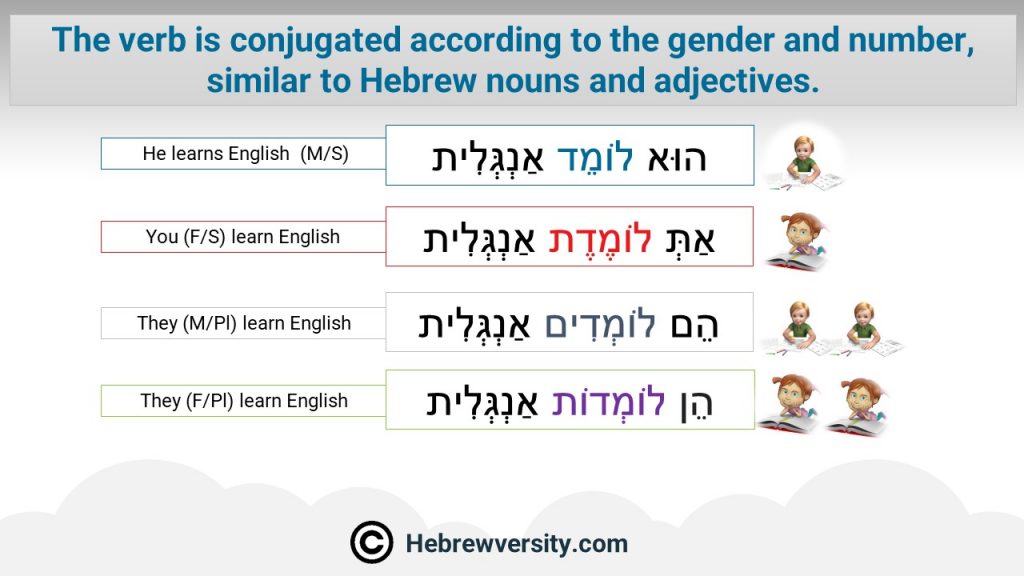
Pa’al is the simplest and most frequently used binyan in Hebrew. It typically expresses straightforward, active actions performed by the subject. Most Hebrew verbs belong to this binyan.
Structure of Pa’al in Present Tense
- No prefix
- Vowel Pattern: o–e depending on the root (as in כּוֹתֵב – “writes”)
- Infinitive Form: לִפְעוֹל – using פ.ע.ל as the placeholder root
The base form is: פּוֹעֵל – where פ.ע.ל is the sample root
Conjugation Table (Using כ.ת.ב – “to write”)
| Person & Gender | Hebrew Form | Transliteration | English Meaning |
| Masculine Singular | כּוֹתֵב | kotev | He writes |
| Feminine Singular | כּוֹתֶבֶת | kotevet | She writes |
| Masculine Plural | כּוֹתְבִים | kotvim | They (m) write |
| Feminine Plural | כּוֹתְבוֹת | kotvot | They (f) write |
Infinitive: לִכְתוֹב (likhtov)
Common Pa’al Verbs in Present Tense
| Verb (Present) | Transliteration | Infinitive | Meaning |
| כּוֹתֵב | kotev | לִכְתוֹב | writes |
| לוֹמֵד | lomed | לִלְמוֹד | studies |
| עוֹבֵד | oved | לַעֲבוֹד | works |
| שׁוֹמֵר | shomer | לִשְׁמוֹר | guards / keeps |
| קוֹרֵא | kore | לִקְרוֹא | reads |
Tip for Learners
Pa’al verbs are the foundation of Hebrew. They’re easy to recognize in the present tense by their lack of prefixes and their simple vowel patterns. Mastering Pa’al gives you access to hundreds of everyday verbs.