
Asking questions is essential to communication, and Hebrew has a rich set of interrogative words (milot she’elah – מילות שאלה) that help you ask who, what, where, when, why, and how.
Hebrew questions can be yes/no or open-ended, and the structure is often simpler than in English – no auxiliary verbs like “do” or “does” are needed.
Common Question Words
| English | Hebrew | Transliteration |
| What | מה | mah |
| Who | מי | mi |
| Where | איפה | eifo |
| When | מתי | matai |
| Why | למה | lama |
| How | איך | eich |
| Which | איזה / איזו | eizeh / eizo (m./f.) |
| How much/many | כמה | kama |
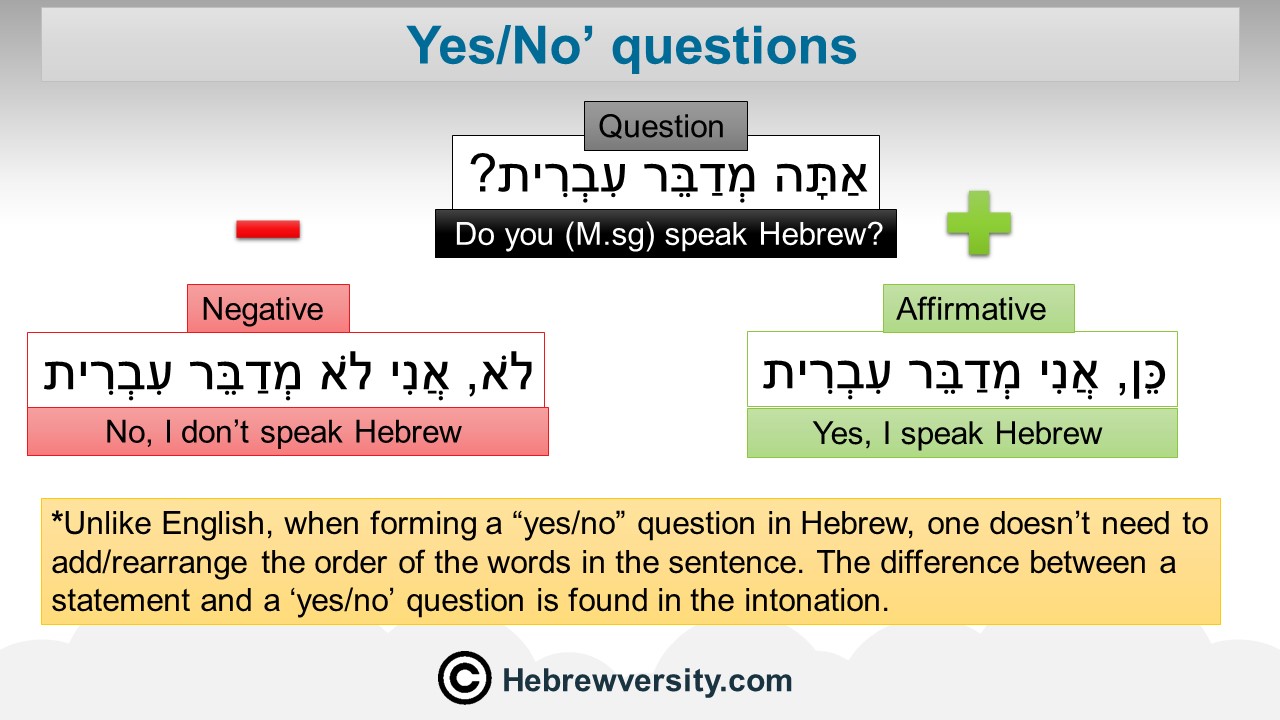
Yes/No Questions
Hebrew yes/no questions are formed by intonation or word order, not by adding a helping verb.
Examples:
- אתה גר כאן? (ata gar kan?) – Do you live here?
- היא אוהבת מוזיקה? (hi ohevet muzikah?) – Does she like music?
Open-Ended Questions
These begin with a question word and follow regular word order.
Examples:
- מה אתה עושה? (mah ata oseh?) – What are you doing?
- איפה הם גרים? (eifo hem garim?) – Where do they live?
- למה אתה עצוב? (lama ata atzuv?) – Why are you sad?
- איך מגיעים לשם? (eich magi’im lesham) – How do you get there?
Biblical and Historical Question Words
In Biblical Hebrew, some question words appear in older or poetic forms. For example:
- אֵי (ei) – Where? (used in poetic or dramatic contexts)
- מַדּוּעַ (madua) – Why? (formal or biblical tone)
- אֵיכָכָה (eichachah) – How? (rare, emotional tone)
These forms are less common in modern speech but appear in scripture, liturgy, and classical texts. Recognizing them helps learners connect modern Hebrew to its ancient roots and understand literary or religious language more deeply.