
In Hebrew, the past tense is used to describe actions that have already happened. Unlike English, Hebrew verbs in the past tense are fully conjugated to reflect the subject’s person, gender, and number – all within the verb itself.
Structure and Logic
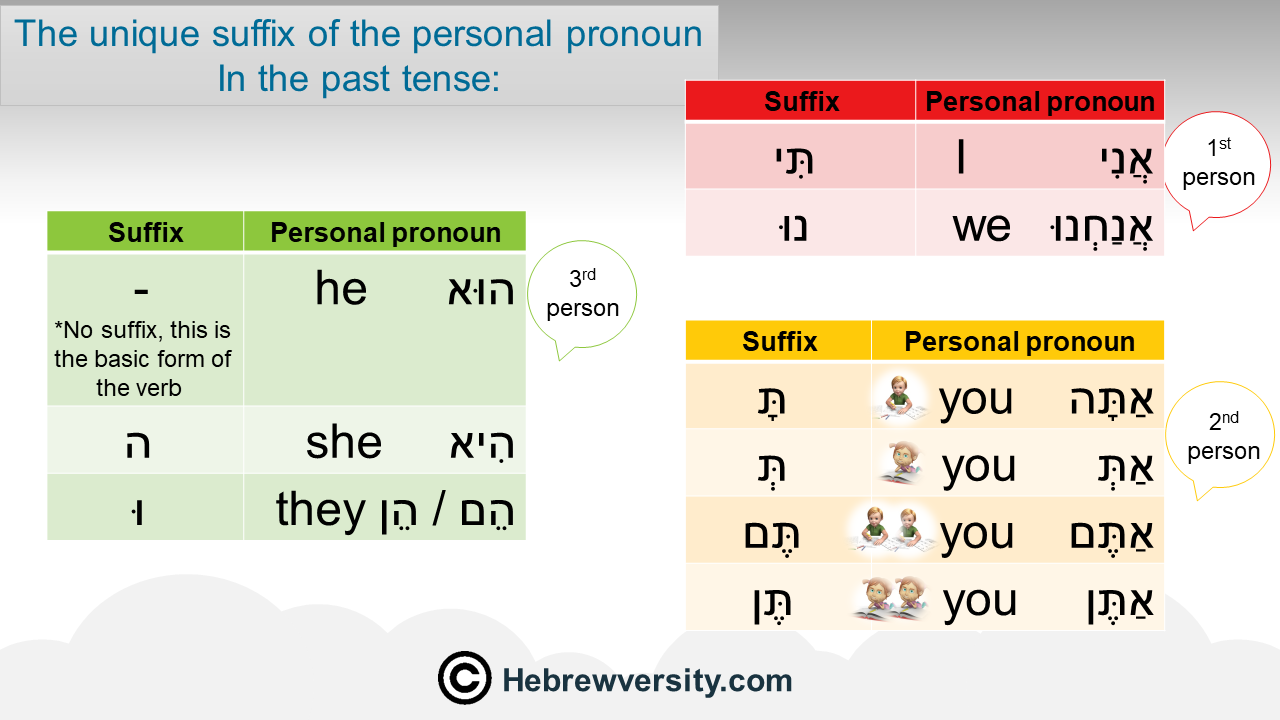
Hebrew verbs are built from a root (shoresh – שורש) and placed into a binyan (verb pattern). In the past tense, each verb form ends with a suffix that tells you who did the action.
There’s no need for auxiliary verbs like “did” or “have” – the verb alone carries the full meaning.
Example: Root כ.ת.ב (k.t.v – related to writing)
| Person & Gender | Hebrew Form | Transliteration | Meaning |
| I (m./f.) | כתבתי | katavti | I wrote |
| You (m. singular) | כתבתָ | katavta | You wrote |
| You (f. singular) | כתבתְ | katavt | You wrote |
| He | כתב | katav | He wrote |
| She | כתבה | katvah | She wrote |
| We (m./f.) | כתבנו | katavnu | We wrote |
| You (m. plural) | כתבתם | katavtem | You wrote |
| You (f. plural) | כתבתן | katavten | You wrote |
| They (m./f.) | כתבו | katvu | They wrote |
Sentence Examples
- אני כתבתי מכתב (ani katavti michtav) – I wrote a letter
- היא כתבה סיפור יפה (hi katvah sipur yafeh) – She wrote a beautiful story
- הם כתבו את התשובה (hem katvu et ha-teshuvah) – They wrote the answer
Quick Tip:
The name of each Hebrew verb pattern (binyan) is usually the third person masculine singular past tense form of a sample verb in that binyan.
Examples:
- Pa’al (פָּעַל) – from אכל (achal) = he ate
- Pi’el (פִּעֵל) – from דיבר (diber) = he spoke
- Hif’il (הִפְעִיל) – from הכריז (hichriz) = he announced
- Hitpa’el (הִתְפַּעֵל) – from התרגש (hitragesh) = he got excited