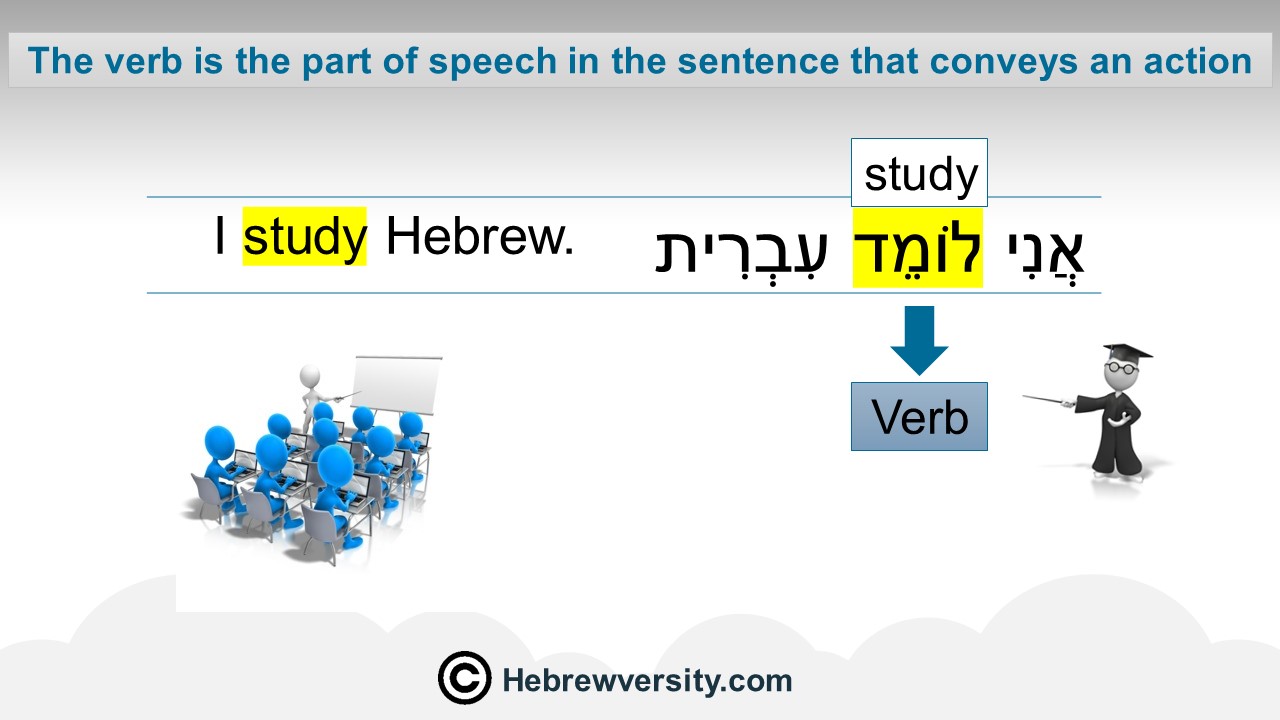
In Hebrew, present tense verbs describe actions or states happening now. Unlike English, Hebrew verbs in the present tense are not conjugated by person (I, you, he/she), but by gender and number – similar to adjectives.
Four Basic Forms
Each verb in the present tense has four forms:
- Masculine singular: כותב (kotev) – writes
- Feminine singular: כותבת (kotevet) – writes
- Masculine plural: כותבים (kotvim) – write
- Feminine plural: כותבות (kotvot) – write
These forms are used with all subjects, regardless of person. The verb does not change for “I,” “you,” or “we” – only for gender and number.
Examples
- אני כותב מכתב – I am writing a letter (said by a male)
- אני כותבת מכתב – I am writing a letter (said by a female)
- הם עובדים בבית – They (m.) are working at home
- הן מדברות עברית – They (f.) speak Hebrew
No “To Be” Verb
Hebrew does not use a verb for “to be” in the present tense. Instead, sentences are built with just the subject and the predicate:
- הוא רופא – He is a doctor
- אנחנו תלמידים – We are students
This makes Hebrew present tense both compact and expressive.