Large Numbers in Hebrew – Tens, Hundreds, and Thousands
Hebrew numbers become more regular as they grow larger.
While single‑digit numbers require gender agreement and have special masculine/feminine forms, large numbers follow simpler patterns — but they still obey one essential rule:
The number must always match the gender of the noun it describes.
This is true for all numbers: units, tens, hundreds, and thousands.
The confusion often comes from how the forms look, not how they behave.
Even when a number seems “masculine” or “feminine” based on its ending, it still agrees with the noun it modifies.
Tens – עשרות
Tens (20, 30, 40, etc.) are formed by adding the masculine plural ending –ים to the unit:
- עֶשְׂרִים (esrim) – twenty
- שְׁלוֹשִׁים (shloshim) – thirty
- אַרְבָּעִים (arba’im) – forty
These forms are grammatically masculine, but here is the key:
Tens do not change form based on the noun’s gender.
They stay the same for masculine and feminine nouns.
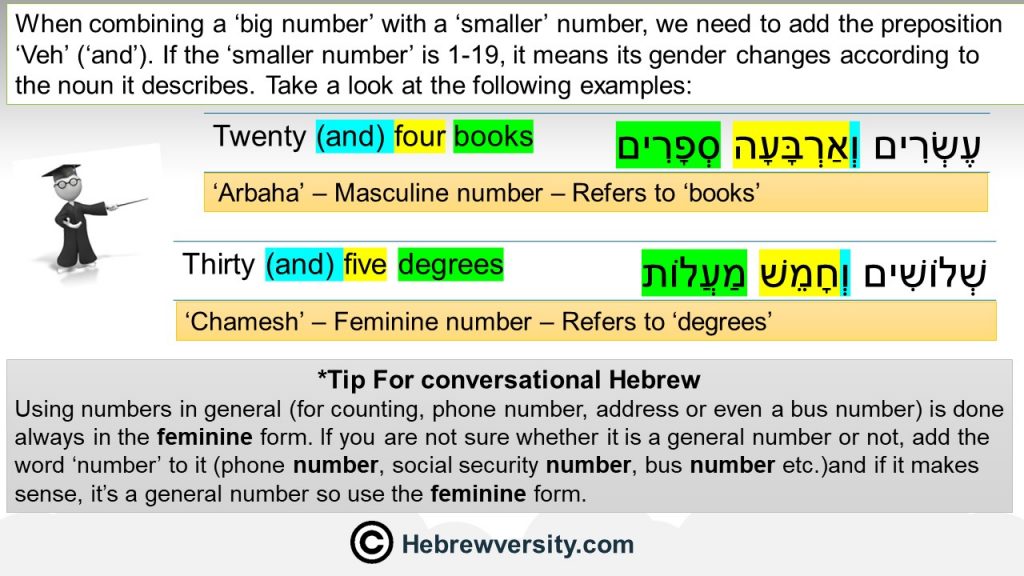
However, when tens combine with units (e.g., 23, 47), the unit must match the noun’s gender.
Examples:
23 books (books = masculine):
עֶשְׂרִים וּשְׁלוֹשָׁה סְפָרִים
esrim u‑shlosha sfarim
23 pictures (pictures = feminine):
עֶשְׂרִים וְשָׁלוֹשׁ תְּמוּנוֹת
esrim ve‑shalosh tmunot
Only the unit changes — because it describes the noun.
Hundreds – מאות
The word for “hundred” is:
- מֵאָה (me’ah) – one hundred
- מֵאוֹת (me’ot) – hundreds
The number two hundred uses a special dual form:
- מָאתַיִם (matayim) – two hundred
For 300 and above, Hebrew uses the regular pattern:
- שְׁלוֹשׁ מֵאוֹת (shlosh me’ot) – three hundred
- אַרְבַּע מֵאוֹת (arba me’ot) – four hundred
The small number (3, 4, 5…) must match the gender of the noun it describes —
not the word “hundred.”
Example:
300 books (books = masculine):
שְׁלוֹשׁ מֵאוֹת סְפָרִים
shlosh me’ot sfarim
300 pictures (pictures = feminine):
שְׁלוֹשׁ מֵאוֹת תְּמוּנוֹת
shlosh me’ot tmunot
The form שְׁלוֹשׁ is feminine in appearance, but it matches the noun (books/pictures), not “hundreds.”
Thousands – אלפים
The word for “thousand” is:
- אֶלֶף (elef) – one thousand
- אֲלָפִים (alafim) – thousands
The dual form is:
- אַלְפַּיִם (alpayim) – two thousand
For 3,000 and above, Hebrew uses the construct form:
- שְׁלוֹשֶׁת אֲלָפִים (shloshet alafim) – three thousand
- אַרְבַּעַת אֲלָפִים (arba’at alafim) – four thousand
Again, the small number (3, 4, 5…) must match the noun being counted —
not the word “thousand.”
Example:
3,000 books (books = masculine):
שְׁלוֹשֶׁת אֲלָפִים סְפָרִים
shloshet alafim sfarim
3,000 pictures (pictures = feminine):
שְׁלוֹשֶׁת אֲלָפִים תְּמוּנוֹת
shloshet alafim tmunot
The Formula for Large Numbers
Hebrew builds large numbers using a simple structure:
[Small number] + [Large number] + [Noun]
And the key rule:
The small number always matches the noun — not the large number.
Examples:
- שְׁלוֹשׁ מֵאוֹת סְפָרִים
shlosh me’ot sfarim
“three hundred books” - אַרְבַּעַת אֲלָפִים תְּמוּנוֹת
arba’at alafim tmunot
“four thousand pictures”
This rule is consistent across all large numbers.
Summary
- Tens have fixed masculine forms, but units still match the noun.
- Hundreds and thousands use special forms, but the small number always agrees with the noun.
- The appearance of the number (ending with ה or not) does not change the agreement rule.
- Hebrew large numbers follow a clear formula:
small number → large number → noun,
with the small number matching the noun’s gender.