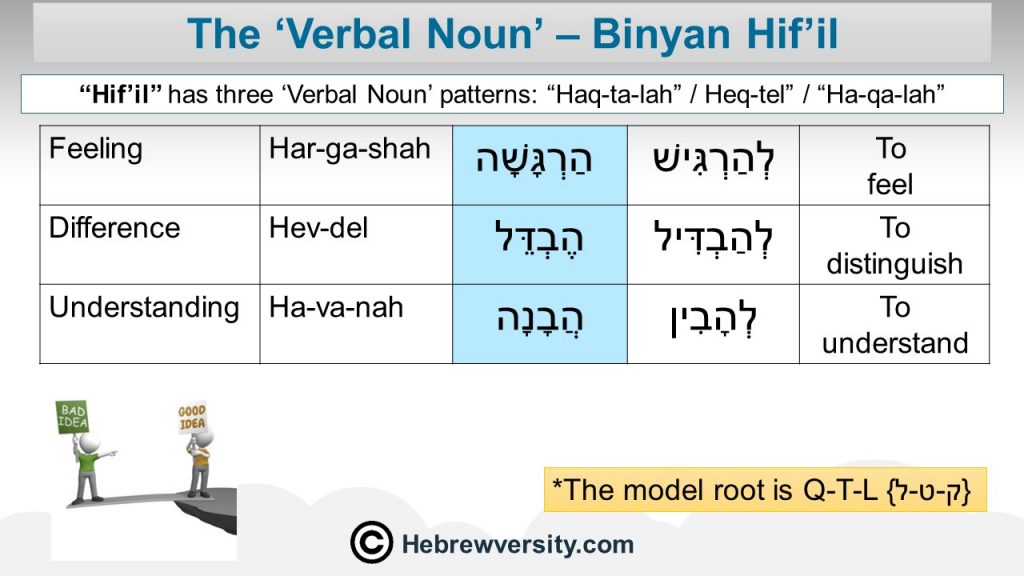
In Hebrew, a verbal noun (shem ha-pe’ulah) is a noun that expresses the action or process of a verb. It’s similar to English words like “writing,” “decision,” or “conversation” – nouns that come from verbs and describe the activity itself.
Each Hebrew verb belongs to a binyan (verb pattern), and each binyan has its own typical way of forming verbal nouns. These patterns are often predictable and help learners recognize related words and expand their vocabulary.
Common Patterns by Binyan
| Binyan | Example Verb | Verbal Noun | Meaning |
| פָּעַל (Pa’al) | לכתוב – to write | כתיבה (ktivah) | writing |
| פִּעֵל (Pi’el) | לדבר – to speak | דיבור (dibur) | speech |
| הִפְעִיל (Hif’il) | להחליט – to decide | החלטה (hachlatah) | decision |
| נִפְעַל (Nif’al) | להישמר – to be kept | הישמרות (hishmarut) | self-protection |
| הִתְפַּעֵל (Hitpa’el) | להתכתב – to correspond | התכתבות (hitkatvut) | correspondence |
What to Notice
- Most verbal nouns are feminine and often end in “-ה”, or “-ות”, like הישמרות.
- The verbal noun reflects the nature of the action, not the person doing it.
- Some roots produce more than one verbal noun depending on context or nuance.
Examples in Sentences
- אני אוהב כתיבה יצירתית – I love creative writing
- ההחלטה הייתה קשה – The decision was difficult
- ההתכתבות נמשכה שבועיים – The correspondence lasted two weeks
- הישמרות מפני אש חשובה מאוד – Protection from fire is very important
Why It Matters
Learning verbal noun patterns helps you:
- Understand abstract ideas in Hebrew
- Expand your vocabulary from familiar verbs
Read formal and academic Hebrew with greater ease