
After Cain and Abel had grown up, the Bible tells us the following:
“…Now Abel kept flocks, and Cain worked the soil. In the course of time Cain brought some of the fruits of the soil as an offering to the LORD. And Abel also brought an offering—fat portions from some of the firstborn of his flock. The LORD looked with favor on Abel and his offering, but on Cain and his offering he did not look with favor. So Cain was very angry, and his face was downcast.” (Genesis 4:2-6)
This biblical description gave rise to one of the most well-known questions that has occupied the minds of numerous theologians, bible commentators and scholars over the centuries – why did God FAVOR Abel’s offering and REJECT Cain’s offering?
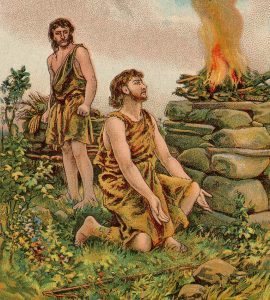
Many answers have been given to this question. I would like to outline one possible answer, which is based on understanding the original Hebrew.
In the original Hebrew, the phrase ‘Now Abel kept flocks, and Cain worked the soil’ sounds like their PROFESSIONS and not simply the description of the ACTIONS they performed.
In other words, when one reads this phrase in the original Hebrew, one should read the following verse ‘Now Abel kept flocks, and Cain worked the soil’ as ‘Now Abel was a shepherd, and Cain was a farmer.’
What is the difference, you ask?
Well, the difference is in the special – very tiny but crucial– detail which is manifested in Biblical Hebrew and this is the usage of the Hebrew verb ‘Li-Hi’yot’ {להיות} which is ‘to be’:
‘Now Abel WAS a shepherd, and Cain WAS a farmer.’
In the original Hebrew it is written ‘Va-Yehi’ {ויהי} when speaking about Abel BUT the Bible uses ‘Hayah’ {היה} when speaking about Cain. The difference between the two forms of the Hebrew verb ‘to be’ is that the first one (‘Va-Yehi’) suggest that ‘it was forced upon’ Abel while the second form of this verb (‘Hayah’) suggests a ‘choice’ for Cain.
In other words, Biblical Hebrew has a unique way to distinguish between the concept of ‘to be’ when it is not one’s choice and ‘to be’ when one actually has chosen something or is at the very least happy with the situation.
The meaning of this not-so-minor detail at all is that according to the original Hebrew, Abel was FORCED to be a shepherd while Cain CHOSE or was simply was happy to be a farmer.
Given the new information, it becomes clear that Cain and Abel were NOT at the same status when they brought their offerings before God and thus God treated them differently in accordance to their offerings.
Having said that, it appears that something is still missing and there is more to it. The full answer to this question will be given in the second part of this post… so stay tuned…