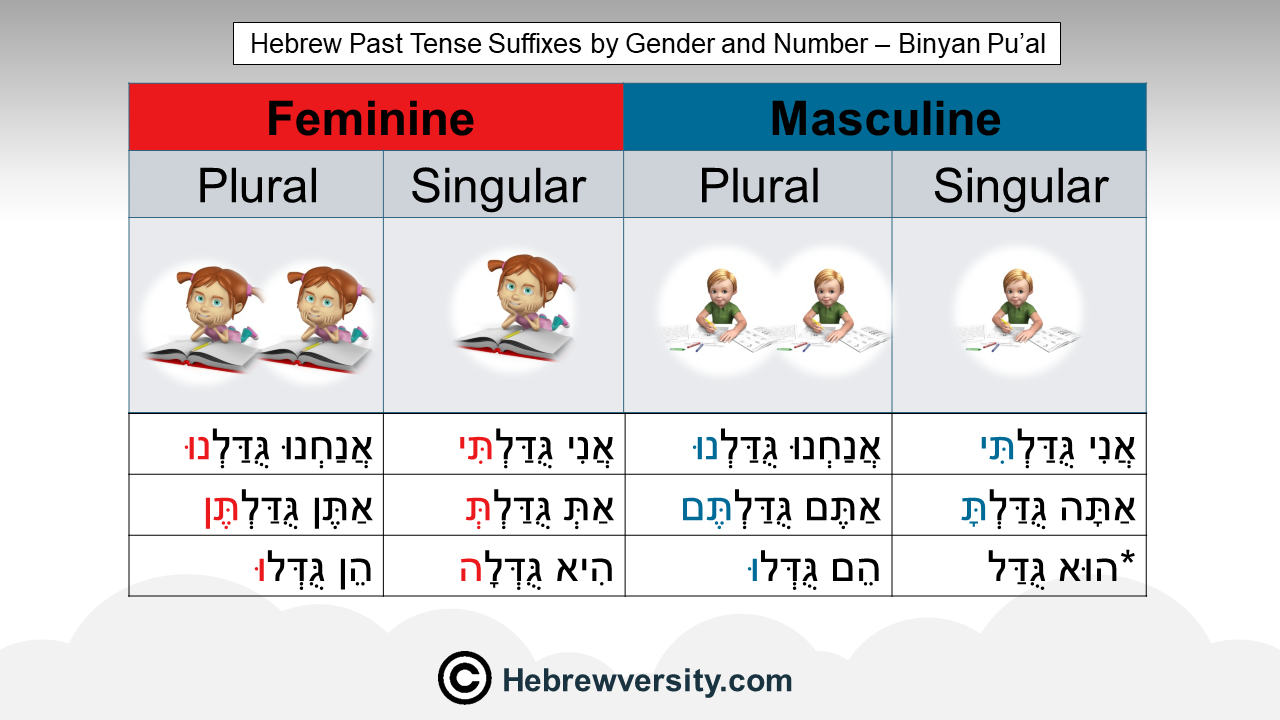
Pu’al is the passive counterpart of Pi’el. In the past tense, it describes actions that were done to the subject – often in formal or descriptive contexts. These verbs are typically used when the subject receives or experiences an action, such as “was cooked,” “was organized,” or “was requested.”
Structure of Pu’al in Past Tense
- No prefix
- Vowel Pattern: u–a (as in סֻדַּר – “was organized”)
- Middle Root Letter: Doubled (marked with a dagesh)
The base form is: פֻּעַל – using the root פ.ע.ל
Conjugation Table (Using ס.ד.ר – “to be organized”)
| Person & Gender | Hebrew Form | Transliteration | English Meaning |
| I | סֻדַּרְתִּי | sudarti | I was organized |
| You (m) | סֻדַּרְתָּ | sudarta | You were organized |
| You (f) | סֻדַּרְתְּ | sudart | You were organized |
| He | סֻדַּר | sudar | He was organized |
| She | סֻדְּרָה | sudrah | She was organized |
| We | סֻדַּרְנוּ | sudarnu | We were organized |
| You (pl) | סֻדַּרְתֶּם/ן | sudartem/sudarten | You were organized |
| They | סֻדְּרוּ | sudru | They were organized |
Common Pu’al Verbs in Past Tense
| Verb (Past) | Transliteration | Meaning |
| סֻדַּר | sudar | was organized |
| קֻבַּל | kubal | was accepted |
| בֻּקַּשׁ | bukash | was requested |
| צֻיֵּר | tzuyar | was drawn |
| בֻּשַּׁל | bushal | was cooked |
Tip for Learners
Pu’al verbs in the past tense describe actions that happened to the subject. They’re easy to recognize by their u–a vowel pattern and the doubled middle root letter. These verbs are more common in written Hebrew, especially in reports, instructions, or formal descriptions.