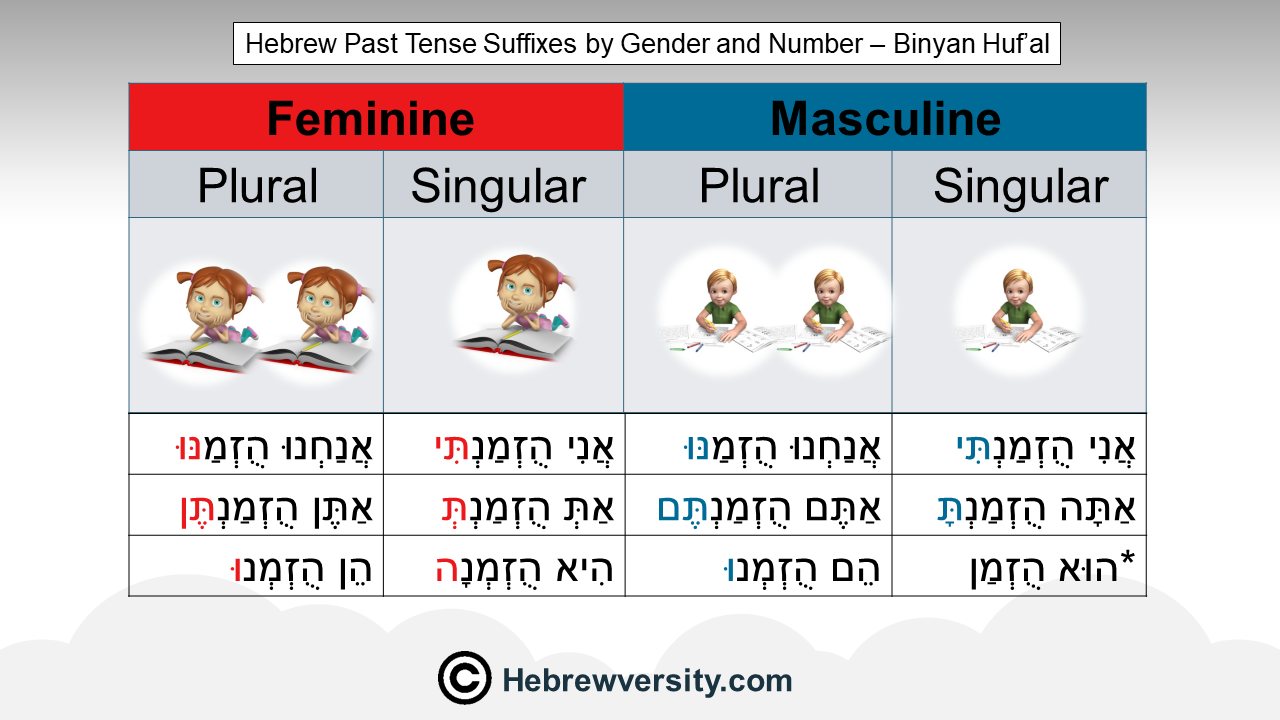
Huf’al is the passive counterpart of Hif’il. In the past tense, it describes actions that were caused to happen to the subject – often by someone else. These verbs are typically used in formal or descriptive contexts, such as “was activated,” “was influenced,” or “was enlarged.”
Structure of Huf’al in Past Tense
- Prefix: הֻ (hu-)
- Vowel Pattern: u–a (as in הֻכְנַס – “was brought in”)
The base form is: הֻפְעַל – using the root פ.ע.ל
Conjugation Table (Using כ.נ.ס – “to be brought in”)
| Person & Gender | Hebrew Form | Transliteration | English Meaning |
| I | הֻכְנַסְתִּי | hukhnasti | I was brought in |
| You (m) | הֻכְנַסְתָּ | hukhnasta | You were brought in |
| You (f) | הֻכְנַסְתְּ | hukhnast | You were brought in |
| He | הֻכְנַס | hukhnas | He was brought in |
| She | הֻכְנְסָה | hukhnesah | She was brought in |
| We | הֻכְנַסְנוּ | hukhnasnu | We were brought in |
| You (pl) | הֻכְנַסְתֶּם/ן | hukhnastem/hukhnasten | You were brought in |
| They | הֻכְנְסוּ | hukhnesu | They were brought in |
Common Huf’al Verbs in Past Tense
| Verb (Past) | Transliteration | Meaning |
| הֻכְנַס | hukhnas | was brought in |
| הֻפְעַל | huf’al | was activated |
| הֻגְדַל | hugdal | was enlarged |
| הֻשְׁפַּע | hushpa | was influenced |
| הֻצְלַח | hutzlakh | was succeeded |
Tip for Learners
Huf’al verbs in the past tense describe actions that were caused to happen to the subject. They’re easy to recognize by the הֻ prefix and the u–a vowel pattern. These verbs are common in formal writing, technical language, and descriptions of processes or outcomes.