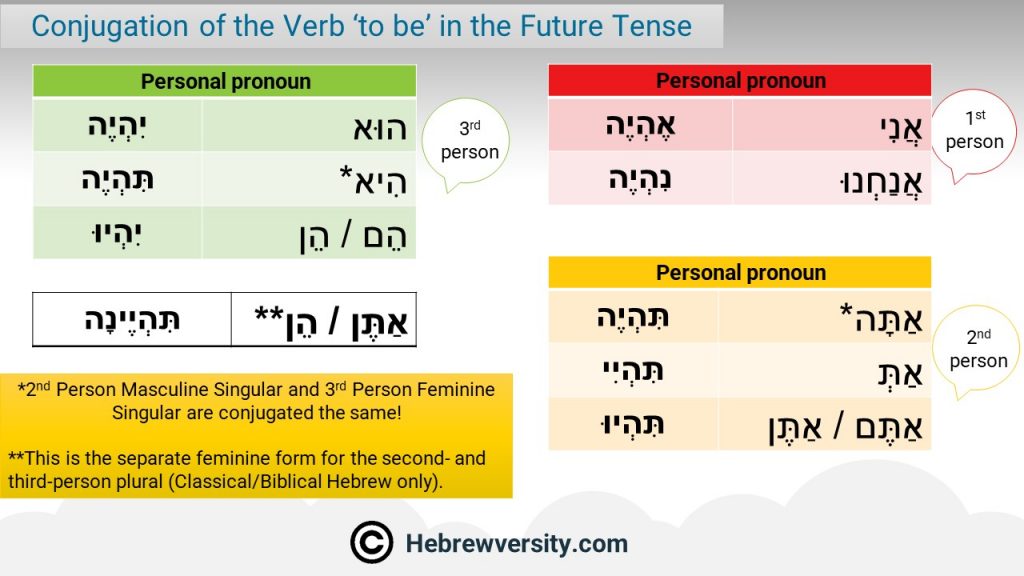
In Hebrew, the verb “to be” in the future tense is expressed using forms of the verb יִהְיֶה (yihyeh), meaning “will be.” Unlike the present tense, where “to be” is usually omitted, the future tense uses full conjugation to express what someone or something will be.
Why It Matters
Mastering future forms of “to be” helps learners describe:
- What someone will become
- Where something will be located
- What a situation will be like
This is especially useful in formal speech, writing, and planning.
Conjugation of יהיה – “To Be” (Future Tense)
| Person & Gender | Hebrew Form | Transliteration | English Meaning |
|---|---|---|---|
| I | אֶהְיֶה | ehyeh | I will be |
| You (m) | תִּהְיֶה | tihyeh | You will be (m) |
| You (f) | תִּהְיִי | tihyi | You will be (f) |
| He | יִהְיֶה | yihyeh | He will be |
| She | תִּהְיֶה | tihyeh | She will be |
| We | נִהְיֶה | nihyeh | We will be |
| You (pl) | תִּהְיוּ | tihyu | You will be (pl) |
| They | יִהְיוּ | yihyu | They will be |
Examples in Modern Hebrew
- אני אהיה מוכן מחר – I will be ready tomorrow
- היא תהיה רופאה בעתיד – She will be a doctor in the future
- אנחנו נהיה בבית בערב – We will be at home in the evening
- הם יהיו שמחים לשמוע את זה – They will be happy to hear that
Quick Tips for Learners
- The verb יִהְיֶה is irregular, and its future forms are unique – especially אֶהְיֶה, which starts with א and includes a guttural ה.
- Hebrew uses these forms to express future identity, location, or condition.
- In casual speech, future “to be” is often implied, but in writing and formal contexts, it’s clearly stated.