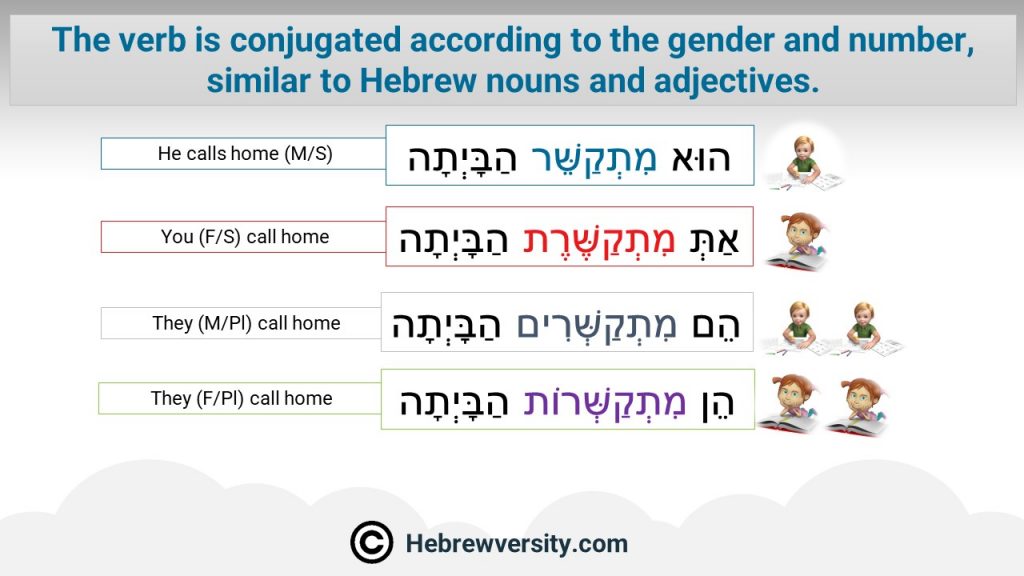
Hitpa’el is the reflexive binyan in Hebrew. Verbs in this pattern often describe actions that a subject performs on itself, mutual actions, or behaviors. It’s commonly used for verbs like “to get dressed,” “to behave,” or “to apologize.”
Structure of Hitpa’el in Present Tense
- Prefix: מִתְ (mit-)
- Vowel Pattern: i-a-e (as in מִתְנַהֵג – “behaves”)
- Infinitive Form: לְהִתְפַּעֵל – using פ.ע.ל as the placeholder root
The base form is: מִתְפַּעֵל – where פ.ע.ל is the sample root
Conjugation Table (Using נ.ה.ג – “to behave”)
| Person & Gender | Hebrew Form | Transliteration | English Meaning |
| Masculine Singular | מִתְנַהֵג | mitnaheg | He behaves |
| Feminine Singular | מִתְנַהֶגֶת | mitnaheget | She behaves |
| Masculine Plural | מִתְנַהֲגִים | mitnahagim | They (m) behave |
| Feminine Plural | מִתְנַהֲגוֹת | mitnahagot | They (f) behave |
Infinitive: לְהִתְנַהֵג (lehitnaheg)
Common Hitpa’el Verbs in Present Tense
| Verb (Present) | Transliteration | Infinitive | Meaning |
| מִתְנַהֵג | mitnaheg | לְהִתְנַהֵג | behaves |
| מִתְרַגֵּשׁ | mitragesh | לְהִתְרַגֵּשׁ | gets excited |
| מִתְאַמֵּן | mit’amen | לְהִתְאַמֵּן | trains / practices |
| מִתְקַדֵּם | mitkadem | לְהִתְקַדֵּם | progresses |
| מִתְחַבֵּק | mitchabek | לְהִתְחַבֵּק | hugs (each other) |
Tip for Learners
Hitpa’el verbs are easy to recognize thanks to the מִתְ prefix and the reflexive or mutual meaning. They often describe personal actions, emotions, or interactions.