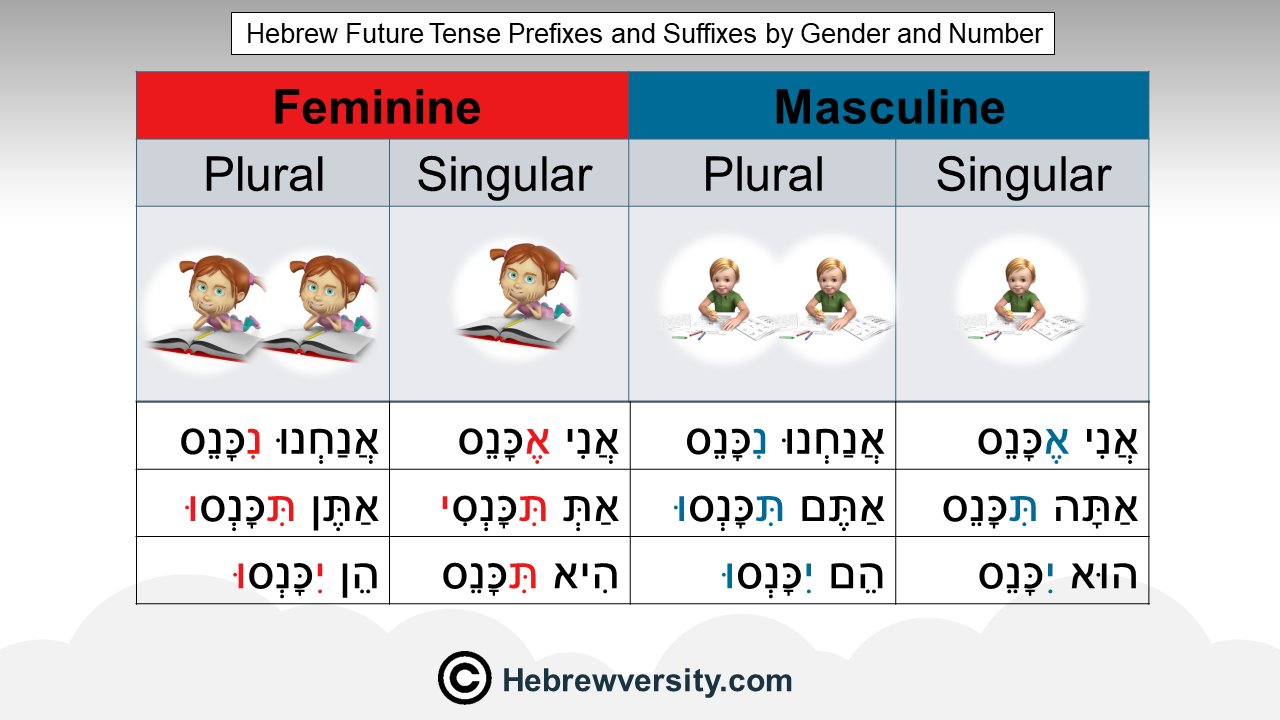
Nif’al is the passive counterpart of Pa’al. In the future tense, it describes actions that will happen to the subject – either passively, reflexively, or spontaneously. These verbs often express entering a state, being affected, or undergoing a process, such as “he will be closed,” “she will be guarded,” or “they will be met.”
Structure of Nif’al in Future Tense
- Prefixes: א / ת / י / נ (depending on person)
- Vowel Pattern: i–a-e or e–a-e depending on the form (as in אֶכָּנֵס – “I will enter”)
- Base Form: יִכָּנֵס – masculine singular, 3rd person
The base form is: יִכָּנֵס – using the root כ.נ.ס
Conjugation Table (Using כ.נ.ס – “to enter”)
| Person & Gender | Hebrew Form | Transliteration | English Meaning |
| I | אֶכָּנֵס | ekanes | I will enter |
| You (m) | תִּכָּנֵס | tikanes | You will enter |
| You (f) | תִּכָּנְסִי | tikanesi | You will enter |
| He (base form) | יִכָּנֵס | yikanes | He will enter |
| She | תִּכָּנֵס | tikanes | She will enter |
| We | נִכָּנֵס | nikanes | We will enter |
| You (pl) | תִּכָּנְסוּ | tikanesu | You will enter |
| They | יִכָּנְסוּ | yikanesu | They will enter |
Common Nif’al Verbs in Future Tense
| Base Form | Transliteration | Meaning |
| יִכָּנֵס | yikanes | will enter |
| יִסָּגֵר | yisager | will be closed |
| יִפָּגֵשׁ | yipagesh | will be met |
| יִשָּׁמֵר | yishamer | will be guarded |
| יִלָּמֵד | yilamed | will be learned |
Tip for Learners
Nif’al verbs in the future tense describe what will happen to the subject. The masculine singular form (יִכָּנֵס) is the base form used in dictionaries.