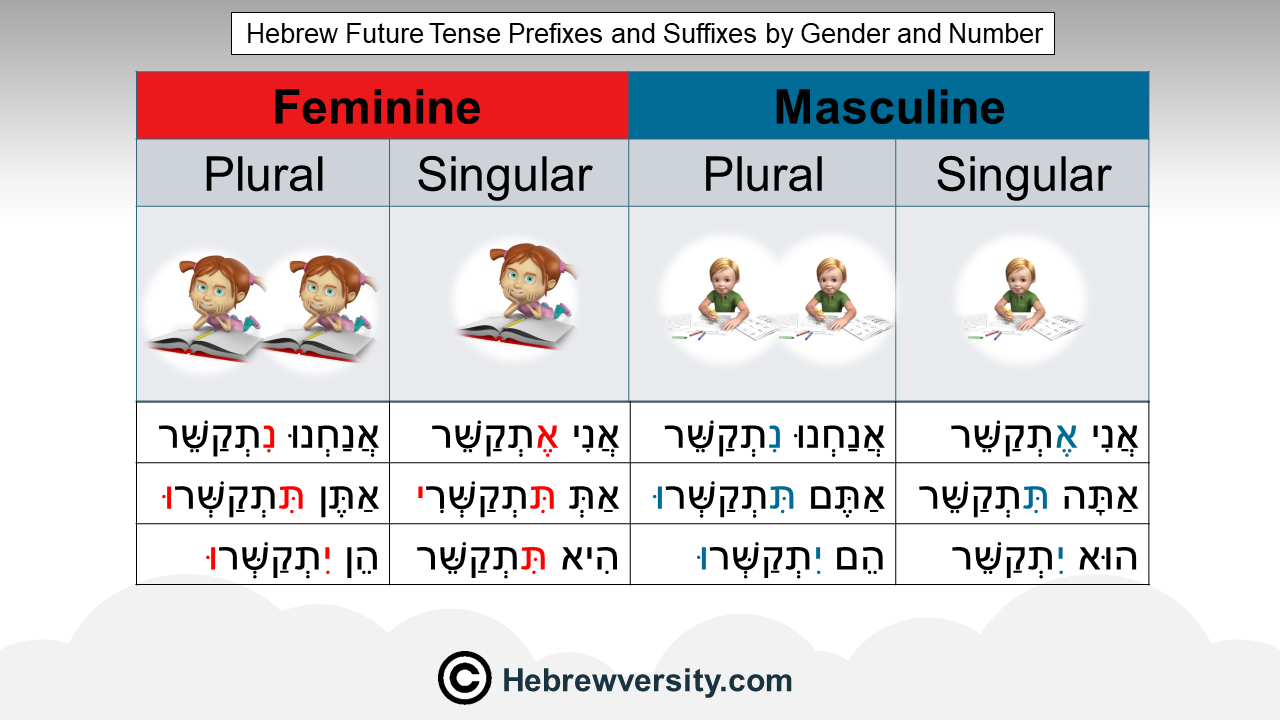
Hitpa’el is the reflexive binyan in Hebrew. In the future tense, it describes actions the subject will perform on itself, or mutual actions between people. These verbs often express personal development, emotional reactions, or social interactions – such as “he will train,” “she will get excited,” or “they will hug.”
Structure of Hitpa’el in Future Tense
- Prefixes: א / ת / י / נ (depending on person)
- Vowel Pattern: i–a-e or e–a-e depending on the form (as in אֶתְאַמֵּן – “I will train”)
- Base Form: יִתְאַמֵּן – masculine singular, 3rd person
The base form is: יִתְאַמֵּן – using the root א.מ.ן
Conjugation Table (Using א.מ.ן – “to train”)
| Person & Gender | Hebrew Form | Transliteration | English Meaning |
| I | אֶתְאַמֵּן | et’amen | I will train |
| You (m) | תִּתְאַמֵּן | tit’amen | You will train |
| You (f) | תִּתְאַמְּנִי | tit’amni | You will train |
| He (base form) | יִתְאַמֵּן | yit’amen | He will train |
| She | תִּתְאַמֵּן | tit’amen | She will train |
| We | נִתְאַמֵּן | nit’amen | We will train |
| You (pl) | תִּתְאַמְּנוּ | tit’amnu | You will train |
| They | יִתְאַמְּנוּ | yit’amnu | They will train |
Common Hitpa’el Verbs in Future Tense
| Base Form | Transliteration | Meaning |
| יִתְאַמֵּן | yit’amen | will train |
| יִתְנַהֵג | yitnaheg | will behave |
| יִתְרַגֵּשׁ | yitragesh | will get excited |
| יִתְקַדֵּם | yitkadem | will progress |
| יִתְחַבֵּק | hitchabek | will hug |
Tip for Learners
Hitpa’el verbs in the future tense describe mostly reflexive or mutual actions. The masculine singular form (יִתְאַמֵּן) is the base form used in dictionaries.