
“Binyan Nif’al” Present Tense
Nif’al is the passive counterpart of Pa’al. Verbs in this binyan often describe actions that happen to the subject, rather

“Binyan Nif’al” Past Tense
Nif’al is the passive counterpart of Pa’al. In the past tense, it describes actions that happened to the subject- either

“Binyan Nif’al” Future Tense
Nif’al is the passive counterpart of Pa’al. In the future tense, it describes actions that will happen to the subject
The Meaning Of “Binyan Nif’al”
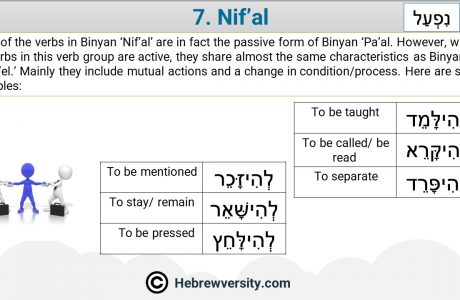
Binyan Nif’al is a verb pattern that typically expresses passive or reflexive action. It often shows that the subject either
Binyan Nif’al Infinitive
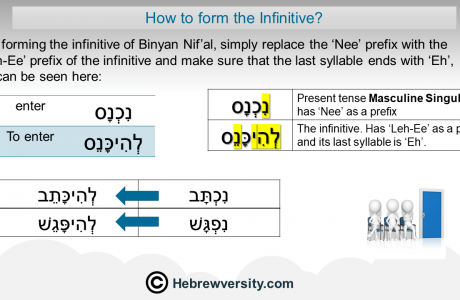
The infinitive in Nif’al expresses the basic idea of a passive or reflexive action – like “to be opened,” “to

Binyan Nif’al Imperative
The imperative in Nif’al is used to give commands or requests in a passive or reflexive sense – often telling
Binyan Nif’al Verbal Noun
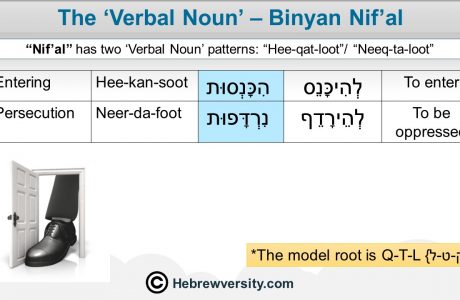
The verbal noun in Nif’al expresses a passive, reflexive, or inward-directed action as a noun – like “separation,” “self-protection,” or

Binyan Nif’al: Present Tense – “Peh-Nun”
In the Nif’al binyan, roots that begin with nun (נ) undergo assimilation in the present tense. The nun disappears, and

Binyan Nif’al: Past Tense – “Peh-Nun”
In the Nif’al binyan, roots that begin with nun (נ) undergo assimilation in the past tense just as they do