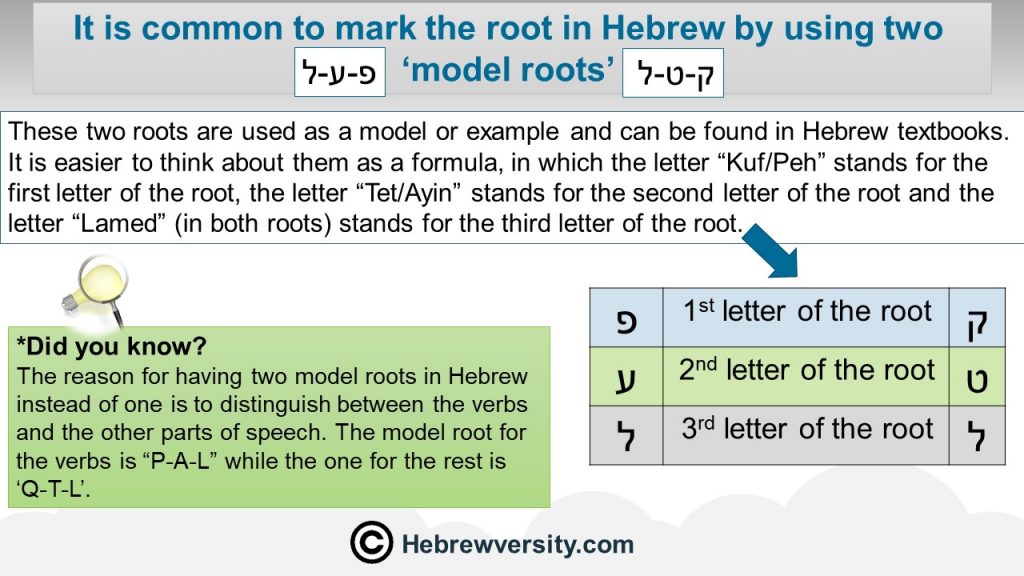
In Hebrew, most words are built from roots, called shoreshim in Hebrew. A root is typically made up of three consonants that carry a core meaning. These root letters are then placed into patterns to form verbs, nouns, adjectives, and more.
Understanding roots is key to unlocking the logic and richness of Hebrew vocabulary.
What Is a Root?
A root (shoresh) is a set of three (sometimes four or more) consonants that express a basic idea. For example:
- כ.ת.ב (k.t.v) – relates to writing
- ש.מ.ר (sh.m.r) – relates to guarding or keeping
- א.ה.ב (a.h.v) – relates to love
These roots can be inserted into different binyanim (verb patterns) or mishkalim (noun patterns) to create related words.
One Root, Many Words
From the root כ.ת.ב (k.t.v), we get:
- כתב (katav) – he wrote
- כתיבה (ktivah) – writing
- מכתב (michtav) – letter
- כתובת (ktovet) – address
- כתוב (katuv) – written
This system helps learners recognize connections between words and guess meanings even when encountering new vocabulary.
Why Roots Matter
- They reveal the logic behind word formation
- They help you expand vocabulary quickly
- They connect modern Hebrew to biblical and classical texts
- They make Hebrew feel more structured and intuitive