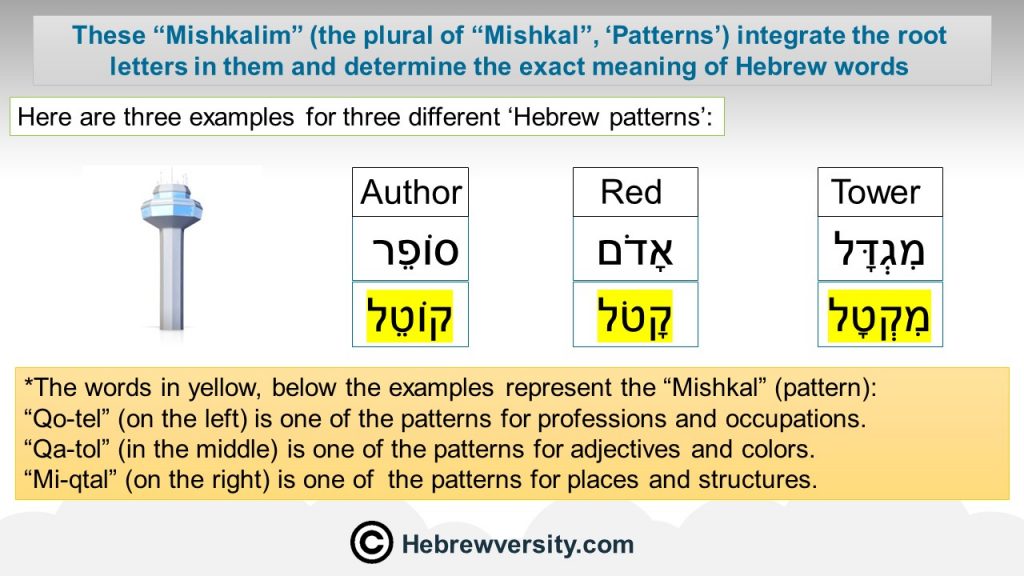
In Hebrew, mishkalim are noun patterns – structured templates that shape how words are formed from roots. Just as binyanim organize verbs, mishkalim organize nouns and adjectives.
Each mishkal gives clues about a word’s meaning, function, and sometimes gender. By learning mishkalim, Hebrew learners can begin to recognize word families and predict meanings even when encountering unfamiliar vocabulary.
What Is a Mishkal?
A mishkal is a pattern of vowels and sometimes extra letters that wraps around a root (shoresh) to create a noun or adjective. The root provides the core meaning, while the mishkal gives grammatical and semantic context.
For example, a root like כ.ת.ב (related to writing) can be placed into different mishkalim to produce words like “writing,” “letter,” or “address” – each with a different nuance.
Why Mishkalim Matter
- They help you decode new words by recognizing familiar patterns
- They reveal relationships between words with shared roots
- They offer insight into abstract ideas, tools, places, and actions
- They connect modern Hebrew to its biblical and classical origins
How Mishkalim Work
Most mishkalim are associated with certain types of meaning:
- Tools or instruments
- Places or locations
- Actions or results of actions
- Qualities or states of being
Some patterns are more common in masculine nouns, others in feminine. Some are productive (used to form new words), while others are fixed and historical.