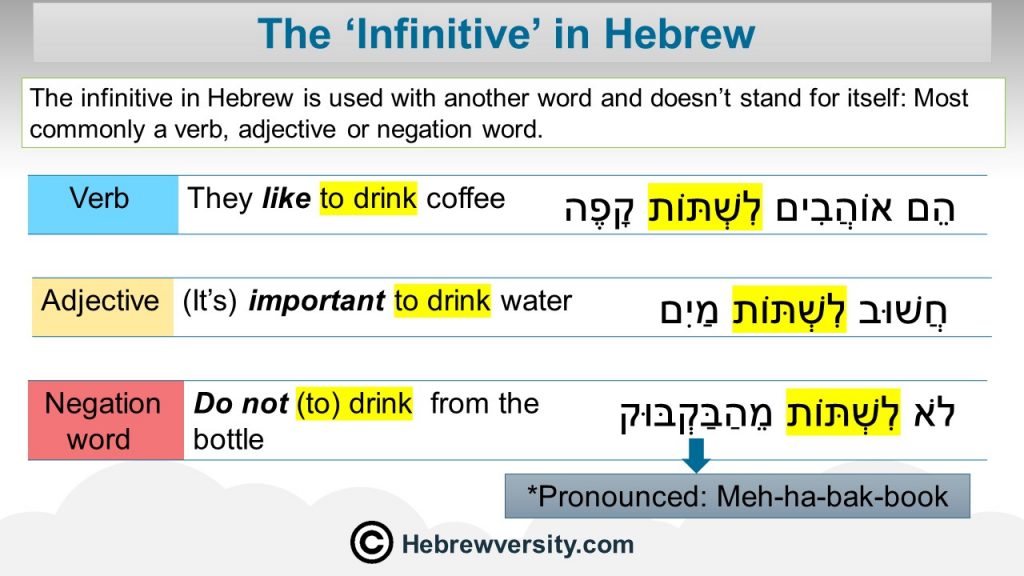
In Hebrew, the infinitive form of the verb – known as שם הפועל (shem hapo’al) – is the basic, unconjugated form that expresses the idea of an action without tying it to a subject, tense, or number. It’s equivalent to “to eat,” “to go,” or “to speak” in English.
How It’s Formed
Most Hebrew infinitives begin with the prefix ל־ (le- or la-), meaning “to,” followed by a verb form that reflects its binyan (verb pattern).
Examples:
- לכתוב (lichtov) – to write
- ללכת (lalechet) – to go
- לדבר (ledaber) – to speak
- לאכול (le’echol) – to eat
Each binyan has its own infinitive structure, and recognizing the pattern helps you identify the verb’s voice and meaning.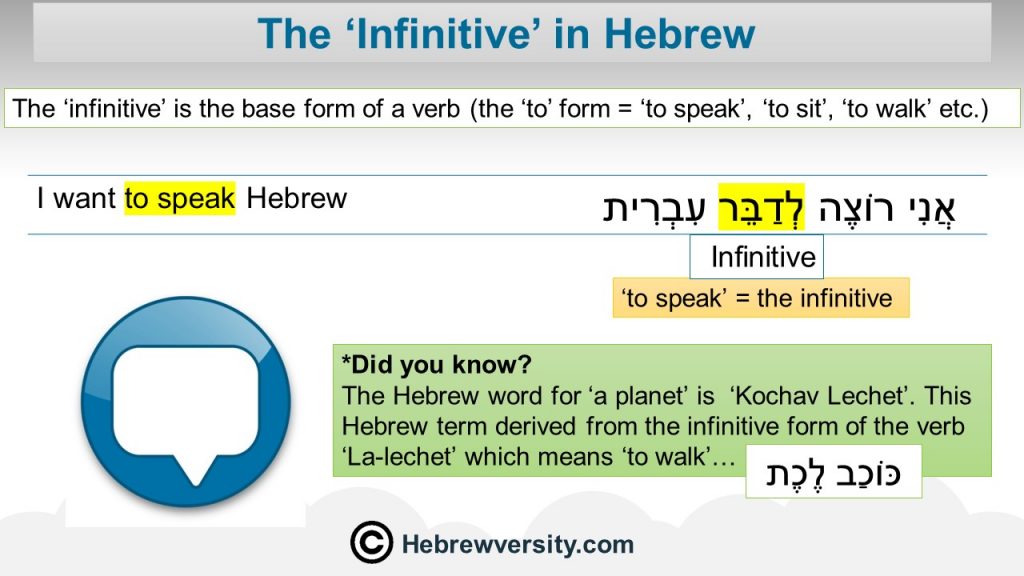
Uses of the Infinitive
The infinitive is used in many contexts:
- After modal expressions:
אני רוצה ללמוד – I want to study
צריך לשלם – One must pay - To express purpose:
באתי לראות אותך – I came to see you - In instructions or signs:
לא לעשן – No smoking
לשמור על השקט – Keep quiet
A Gateway to Verb Mastery
Learning infinitives is a great way to build vocabulary and recognize verb roots. Since they’re not conjugated, they offer a clean starting point for understanding how verbs behave across tenses and binyanim.