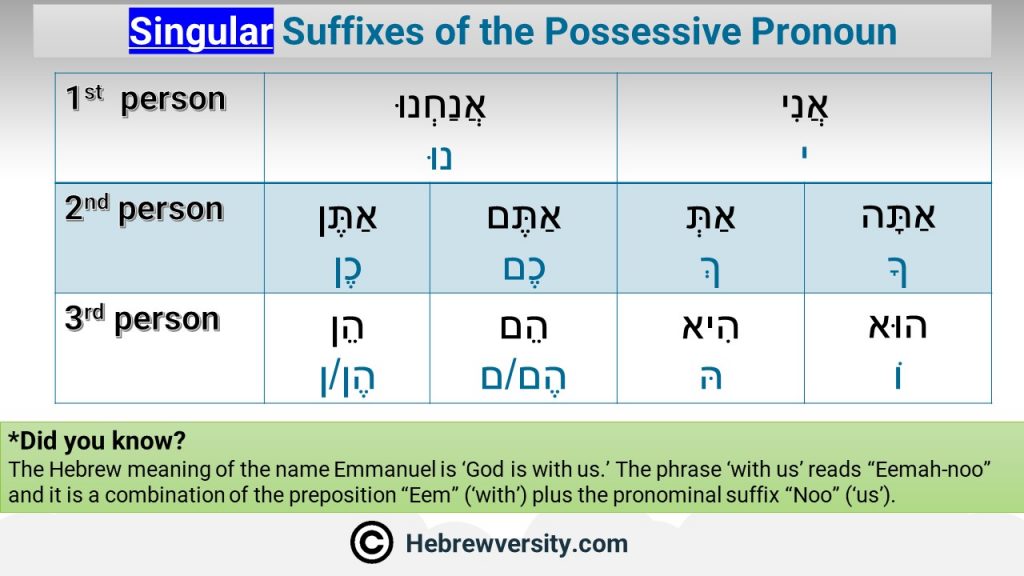
In Hebrew, most prepositions can take pronominal suffixes – short endings that attach directly to the preposition to express relationships like “to me,” “with him,” or “from us.” Instead of using separate pronouns, Hebrew fuses them into a single word.
This feature is widespread and applies to nearly all common prepositions.
How It Works
The pronominal suffix reflects the person (1st, 2nd, 3rd), number (singular/plural), and gender. The preposition itself may change slightly to accommodate the suffix.
Examples:
| Preposition | Meaning | Base Form | “Me” | “Him” | “Us” |
|---|---|---|---|---|---|
| לְ / אֶל | to | לְ / אֶל | לִי / אֵלַי | לוֹ / אֵלָיו | לָנוּ / אֵלֵינוּ |
| בְּ | in / at | בְּ | בִּי | בּוֹ | בָּנוּ |
| עִם | with | עִם | עִמִּי | עִמּוֹ | עִמָּנוּ |
| מִן | from | מִן | מִמֶּנִּי | מִמֶּנּוּ | מִמֶּנּוּ |
Key Notes
- The preposition may undergo vowel changes or consonant doubling (e.g., מִן becomes מִמְּ–).
- These forms are used in both formal and everyday Hebrew.
Examples in Sentences
- הוּא דִּבֵּר עִמִּי – He spoke with me
-
הוּא שָׁמַר עָלֵינוּ – He watched over us
These fused forms are essential for fluent Hebrew and appear frequently in speech, writing, and biblical texts.