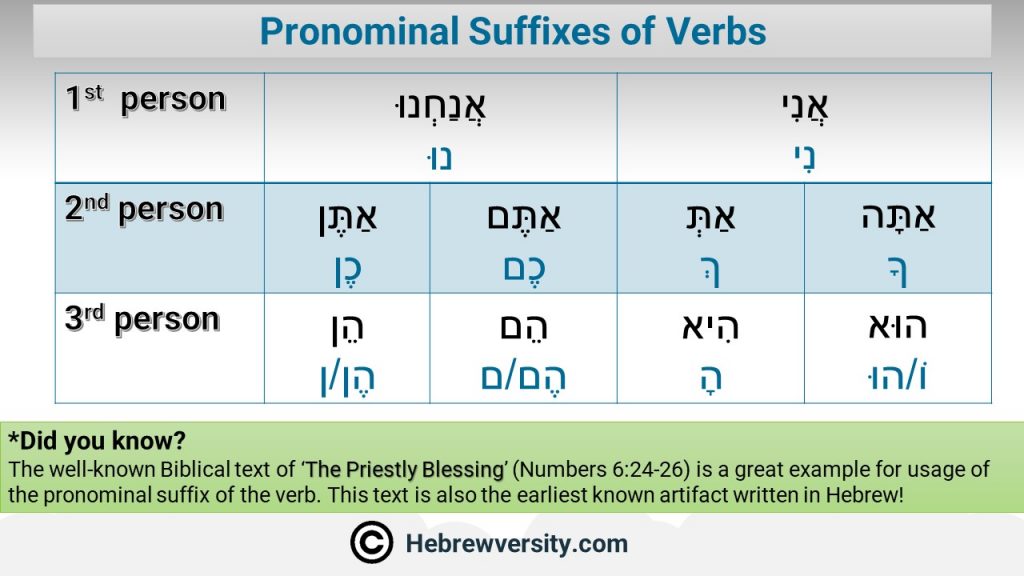
In Hebrew, pronominal suffixes can be attached directly to verbs to express the object of the action –such as “he-saw-me” or “she-loved-him.” These suffixes represent direct objects and fuse with the verb into a single word.
However, this structure is almost entirely absent from modern spoken Hebrew. It appears primarily in biblical texts, liturgical language, and older literary Hebrew.
How It Works (Biblical/Formal Hebrew)
The suffix reflects the person and number of the object. The verb may shift slightly to accommodate the ending.
Examples:
| Verb | Meaning | With Suffix | Meaning |
|---|---|---|---|
| רָאָה | he saw | רְאָהוּ | he saw him |
| שָׁמַר | he guarded | שְׁמָרָהּ | he guarded her |
| פָּגַשׁ | he met | פְּגָשְׁךָ | he met you (m.) |
Modern Hebrew Usage
In everyday Hebrew, these suffixes are almost never used. Instead, speakers use separate object pronouns:
- הוּא רָאָה אוֹתִי – He saw me
- הִיא פָּגְשָׁה אוֹתוֹ – She met him
- הֵם שָׁמְרוּ עָלָיו – They watched over him
These forms are clearer, more natural, and universally understood in modern contexts.
Summary
- Pronominal verb suffixes are a hallmark of Biblical Hebrew
- They are rarely used in speech today
- Understanding them is essential for reading classical texts, but not for everyday conversation