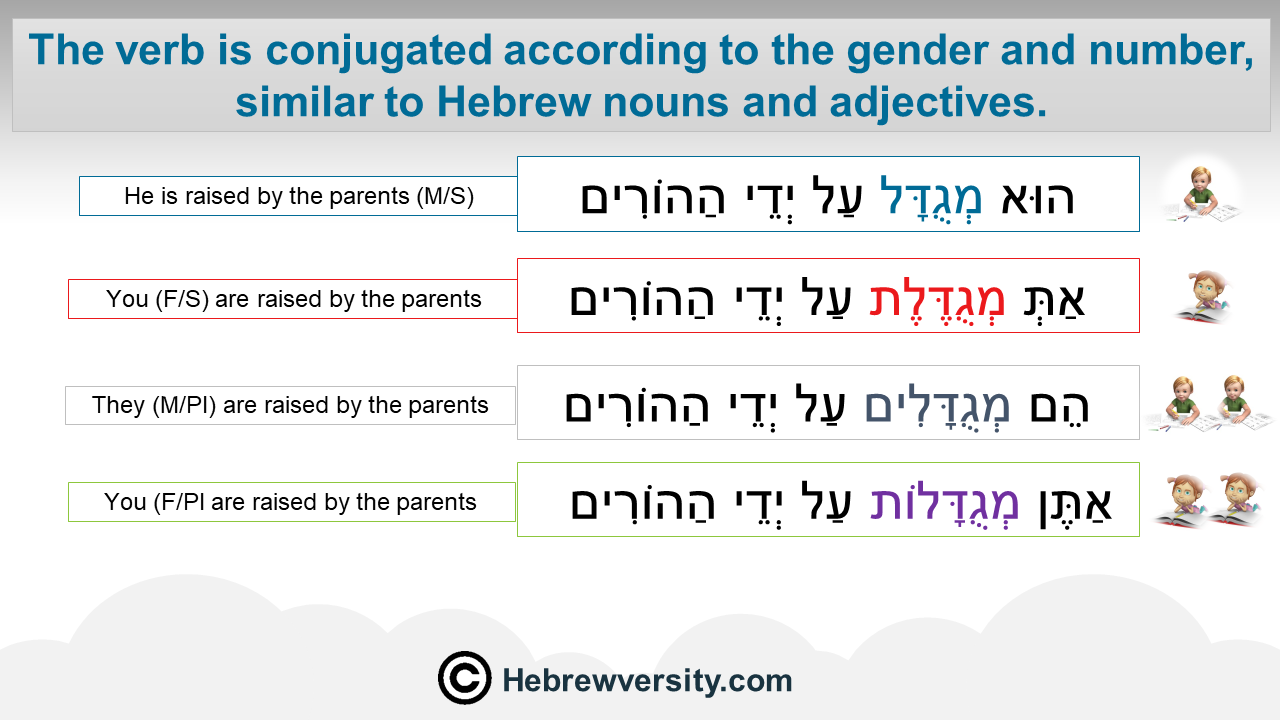
Pu’al is the passive counterpart of Pi’el. Verbs in this binyan describe actions being received or experienced by the subject – something is done to them, rather than by them. Pu’al is less common in everyday speech but appears frequently in formal or descriptive contexts.
Structure of Pu’al in Present Tense
- Prefix: מְ (me-)
- Vowel Pattern: u–a (as in מְסֻדָּר – “is organized”)
- Middle Root Letter: Doubled (marked with a dagesh)
The base form is: מְפֻעָּל – using פ.ע.ל as the placeholder root
Conjugation Table (Using ס.ד.ר – “to be organized”)
| Person & Gender | Hebrew Form | Transliteration | English Meaning |
| Masculine Singular | מְסֻדָּר | mesudar | He is organized |
| Feminine Singular | מְסֻדֶּרֶת | mesuderet | She is organized |
| Masculine Plural | מְסֻדָּרִים | mesudarim | They (m) are organized |
| Feminine Plural | מְסֻדָּרוֹת | mesudarot | They (f) are organized |
Common Pu’al Verbs in Present Tense
| Verb (Present) | Transliteration | Meaning |
| מְסֻדָּר | mesudar | is organized |
| מְקֻבָּל | mekubal | is accepted |
| מְבֻקָּשׁ | mevukash | is requested |
| מְצֻיָּר | metzuyar | is drawn / painted |
| מְבֻשָּׁל | mevushal | is cooked |
Tip for Learners
Pu’al verbs are easy to recognize by their מְ prefix and u–a vowel pattern. They always describe passive actions and often appear in written or formal Hebrew, such as instructions, descriptions, or reports.