hebrewversity
  • About
    • Hebrew Lessons
  • Hebrew Levels
    • “Aleph” (A1)
    • “Bet” (A2)
    • “Gimmel” (B1)
    • “Dalet” (B2)
    • “Heh” (C1)
    • “Vav” (C2)
  • Hebrew Premium
    • Biblical Hebrew and Hebrew Bible Studies Program
    • Modern Hebrew and Israel Studies Program
    • Liturgical Hebrew and Jewish Studies Program
  • Hebrew Freemium
    • Hebrew Alphabet Course
    • Hebrew Grammar and Syntax
      • THE HEBREW VERB SYSTEM​
    • Hebrew Vocabulary By Topics
    • Hebrew Culture, History and Heritage
    • Web Resources in Hebrew
    • Hebrew Materials – Links
  • Log in
  • About
    • Hebrew Lessons
  • Hebrew Levels
    • “Aleph” (A1)
    • “Bet” (A2)
    • “Gimmel” (B1)
    • “Dalet” (B2)
    • “Heh” (C1)
    • “Vav” (C2)
  • Hebrew Premium
    • Biblical Hebrew and Hebrew Bible Studies Program
    • Modern Hebrew and Israel Studies Program
    • Liturgical Hebrew and Jewish Studies Program
  • Hebrew Freemium
    • Hebrew Alphabet Course
    • Hebrew Grammar and Syntax
      • THE HEBREW VERB SYSTEM​
    • Hebrew Vocabulary By Topics
    • Hebrew Culture, History and Heritage
    • Web Resources in Hebrew
    • Hebrew Materials – Links
  • Log in
Home » Hebrew Premium » Hebrew Language Essentials » Hebrew Grammar and Syntax » THE HEBREW VERB SYSTEM​ » Hebrew Verb Groups (Binyanim) » Binyan Pa’al/Qal

Binyan Pa’al/Qal

“Binyan Pa’al/Qal” Present Tense

“Binyan Pa’al/Qal” Present Tense

Pa’al is the simplest and most frequently used binyan in Hebrew. It typically expresses straightforward, active actions performed by the
“Binyan Pa’al/Qal” Past Tense

“Binyan Pa’al/Qal” Past Tense

Pa’al is the most basic and common binyan in Hebrew. In the past tense, it expresses direct, active actions performed
“To be” – Past Tense

“To be” – Past Tense

In Hebrew, the verb “to be” is expressed using forms of the verb הָיָה (hayah), meaning “was.” Unlike English, Hebrew
“Binyan Pa’al/Qal” Future Tense

“Binyan Pa’al/Qal” Future Tense

Pa’al is the most basic and common binyan in Hebrew. In the future tense, it expresses direct, active actions that

“To be” – Future Tense

“To be” – Future Tense

In Hebrew, the verb “to be” in the future tense is expressed using forms of the verb יִהְיֶה (yihyeh), meaning “will
The Meaning Of “Binyan Pa’al/Qal”

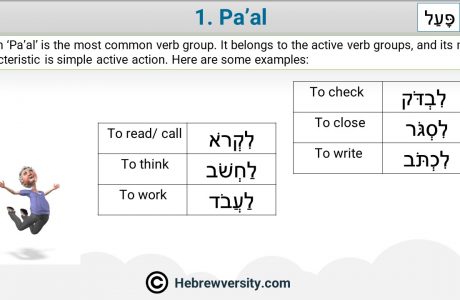
The Meaning Of “Binyan Pa’al/Qal”

Binyan Pa’al, also known as Qal, is the most basic and widely used verb pattern in Hebrew. It expresses simple,
Binyan Pa’al/Qal Infinitive

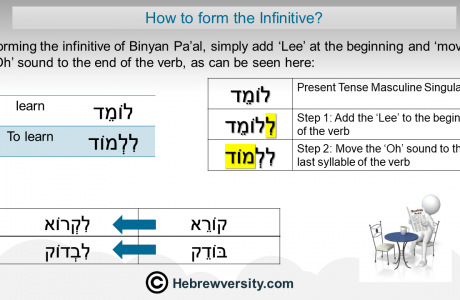
Binyan Pa’al/Qal Infinitive

The infinitive in Pa’al expresses the basic, active meaning of a verb – like “to write,” “to eat,” or “to
Binyan Pa’al/Qal Imperative

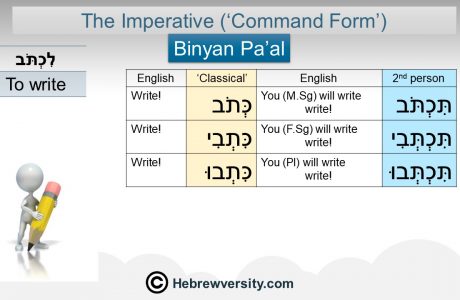
Binyan Pa’al/Qal Imperative

The imperative in Pa’al is used to give direct commands or requests in a simple, active voice – like “Write!”
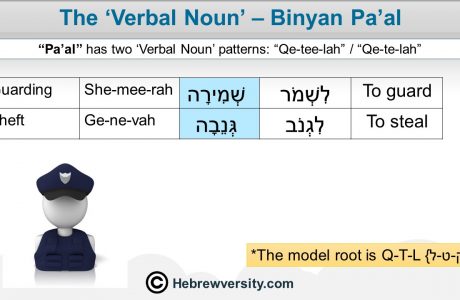
Binyan Pa’al/Qal Verbal Noun

Binyan Pa’al/Qal Verbal Noun

The verbal noun in Pa’al expresses the action of the verb as a noun. It’s often used to describe the
Binyan Pa’al/Qal: Future Tense – “Peh-Nun”

Binyan Pa’al/Qal: Future Tense – “Peh-Nun”

In the Pa’al/Qal binyan, roots that begin with nun (נ) undergo assimilation in the future tense. The initial nun disappears,
Binyan Pa’al/Qal: Future Tense – “Peh-Yud”

Binyan Pa’al/Qal: Future Tense – “Peh-Yud”

Binyan Pa’al: Present Tense – “Ayin-Vav/Yud”

Binyan Pa’al: Present Tense – “Ayin-Vav/Yud”

Binyan Pa’al: Past Tense – “Ayin-Vav/Yud”

Binyan Pa’al: Past Tense – “Ayin-Vav/Yud”

Binyan Pa’al: Future Tense – “Ayin-Vav/Yud”

Binyan Pa’al: Future Tense – “Ayin-Vav/Yud”

Binyan Pa’al: Present Tense – “Lamed-Heh”

Binyan Pa’al: Present Tense – “Lamed-Heh”

Binyan Pa’al: Past Tense – “Lamed-Heh”

Binyan Pa’al: Past Tense – “Lamed-Heh”

Binyan Pa’al: Future Tense – “Lamed-Heh”

Binyan Pa’al: Future Tense – “Lamed-Heh”

Join our newsletter for free Hebrew tips and updates

Monthly Membership ($15)

Learning a new language means learning and understanding a whole new culture. Hebrew is not simply a language but rather a whole culture. To fully understand this magnificent language, one should learn more about its unique history, philosophy, literature and heritage.  For only $15 a month you can gain exclusive access to an absolute treasure trove of high-quality content.
Get Started
How to become a member?
Social networks
  • Facebook
  • Twitter
  • YouTube
Hebrewversity
  • Home page
  • About
  • Articles
  • Hebrew Premium
  • Hebrew Premium – FAQ
  • Hebrew Language Essentials
  • Privacy Policy
  • Terms of Use
  • Newsletter
  • Search
Contact details

Email:
ariel@hebrewversity.com

Powered By adactive | Web Design By Siteos
© All right reserved
Scroll to top
Skip to content
Open toolbar Accessibility Tools

Accessibility Tools

  • Increase TextIncrease Text
  • Decrease TextDecrease Text
  • GrayscaleGrayscale
  • High ContrastHigh Contrast
  • Negative ContrastNegative Contrast
  • Light BackgroundLight Background
  • Links UnderlineLinks Underline
  • Readable FontReadable Font
  • Reset Reset