
The sign of the covenant after the flood is one of the most famous verses in the Bible, and the English translation hides the strangest thing about the Hebrew word for rainbow: “I do set my bow in the cloud, and it shall be for a token of a covenant between me and the earth.” (Genesis 9:13 KJV)
Two Words in English, One Hebrew Word for Rainbow
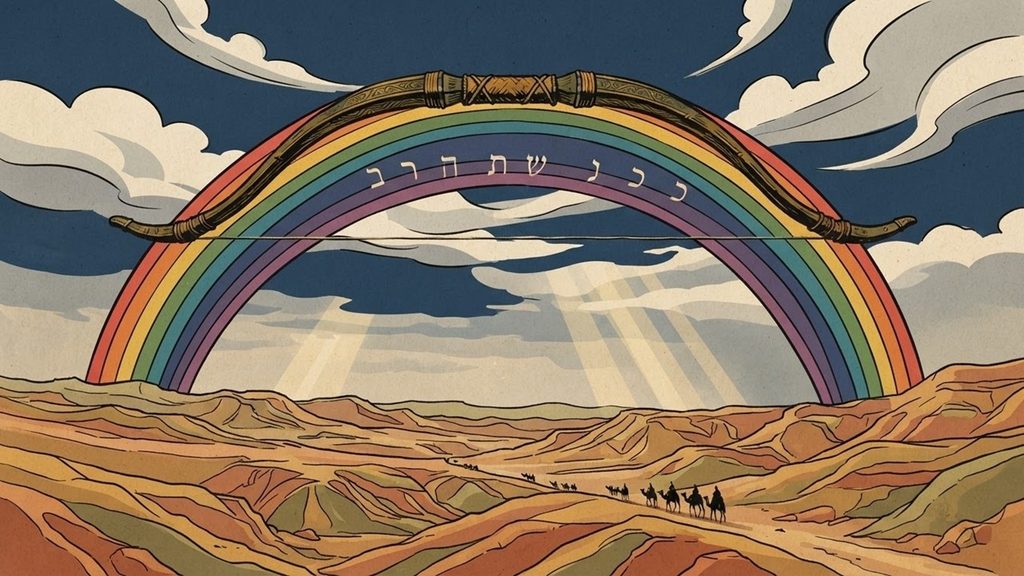
English needs TWO words here, because a bow is a weapon and a rainbow is weather, and no English speaker would ever confuse the two – but in the original Hebrew there is only ONE word for both of them, and it is ‘keshet’ {קשת}.
That means the verse in Genesis does not say that God placed a rainbow in the cloud but that He placed His BOW in the cloud, which is the same word that describes the weapon of a warrior, the thing that shoots arrows, the implement of war.
And the Hebrew Bible never invents a separate word for the rainbow, not once, so wherever you read ‘bow’ in the book of Genesis you are reading ‘keshet’.
A Bow Hung in the Sky Is Aimed at Nothing
A bow is useful only when it is bent, held and pointed at something, and a bow placed in the clouds and left there is a weapon that has been put down – which is precisely the point of the sign.
The warrior’s bow is aimed at the enemy, while the bow of the covenant is bent across the sky with its two ends pointing outward and its curve facing the earth, and that means it is not aimed at the earth at all but hung up above it.
In the original Hebrew the wording is exact, because God says ‘et kashti’ {את קשתי}, MY bow, as if the weapon were His own – so the sign of peace is not a new thing created for the occasion but an existing weapon that has been set aside.
Jewish tradition even prescribes a blessing to be recited upon seeing it, which is a strange thing to do for a weather event and a perfectly natural thing to do for a treaty.
The Same Bow Returns in the Prophets
The word comes back in the vision of Ezekiel, where the glory of the LORD is described as “the appearance of the bow that is in the cloud in the day of rain” (Ezekiel 1:28) – the SAME ‘keshet’, now surrounding the throne rather than hanging over the earth, in the same book where the opening chapter of Genesis is read as an account of order rather than of matter.
It appears again as a lament, because the elegy David composed for Saul and Jonathan is called in the Hebrew ‘keshet’ {קשת} – the Bow – and the text instructs the people to teach it: “Also he bade them teach the children of Judah the use of the bow.” (2 Samuel 1:18)
In Modern Hebrew the word has quietly expanded to cover every arched thing, since ‘keshet’ is the arch of a bridge, the bow of a violin, a curve on a graph and the whole spectrum of colours.
A language that needed ONE word for weapon and weather found it perfectly natural to keep using it for everything else that bends – which is the same habit that makes there is more than one way ‘to speak’ in the Hebrew Bible, where a single root carries meanings an English reader would never connect.
And it is the same economy of language that turns the Garden of Eden into a description of something other than a garden, since a word that names one thing is very often naming two.
Which is why the next time you see a bow in the sky, the Hebrew is telling you something the English cannot – that the arrow was never shot.
Key Takeaways
- The Hebrew word for rainbow is ‘keshet’, which also means bow, highlighting a significant distinction from English.
- Genesis 9:13 refers to God’s ‘bow’ in the clouds, symbolizing a weapon put aside rather than merely a weather phenomenon.
- The bow represents peace, aimed away from the earth, indicating a promise rather than a threat.
- The concept of ‘keshet’ reappears in scriptures, linking it to blessings and teachings about weaponry.
- In Modern Hebrew, ‘keshet’ expands to signify arches and curves, reflecting a linguistic economy in the Hebrew Bible.