hebrewversity
  • About
    • Hebrew Courses and Lectures
  • Hebrew Lessons
    • Hebrew Levels
      • “Aleph” (A1)
      • “Bet” (A2)
      • “Gimmel” (B1)
      • “Dalet” (B2)
      • “Heh” (C1)
      • “Vav” (C2)
  • Hebrew Premium
    • Study Materials – Links
  • Log In
  • Search
  • Hebrew Freemium
    • Hebrew Alphabet Course
    • Hebrew Grammar and Syntax
      • THE HEBREW VERB SYSTEM​
    • Hebrew Vocabulary By Topics
    • Web Resources in Hebrew
    • Hebrew Culture, History and Heritage
  • About
    • Hebrew Courses and Lectures
  • Hebrew Lessons
    • Hebrew Levels
      • “Aleph” (A1)
      • “Bet” (A2)
      • “Gimmel” (B1)
      • “Dalet” (B2)
      • “Heh” (C1)
      • “Vav” (C2)
  • Hebrew Premium
    • Study Materials – Links
  • Log In
  • Search
  • Hebrew Freemium
    • Hebrew Alphabet Course
    • Hebrew Grammar and Syntax
      • THE HEBREW VERB SYSTEM​
    • Hebrew Vocabulary By Topics
    • Web Resources in Hebrew
    • Hebrew Culture, History and Heritage
Home » Hebrew Premium » Hebrew Language Essentials » Hebrew Grammar and Syntax » THE HEBREW VERB SYSTEM​ » Hebrew Verb Groups (Binyanim) » Binyan Pi’el

Binyan Pi’el

“Binyan Pi’el” Present Tense

“Binyan Pi’el” Present Tense

Pi’el is one of Hebrew’s most expressive verb patterns. It often conveys an intensive, repetitive, or causative action compared to
“Binyan Pi’el” Past Tense

“Binyan Pi’el” Past Tense

Pi’el is an expressive and active binyan. In the past tense, it continues to convey intensive, repetitive, or causative actions.
“Binyan Pi’el” Future Tense

“Binyan Pi’el” Future Tense

Pi’el is an expressive and active binyan. In the future tense, it continues to convey intensive, repetitive, or deliberate actions.
The Meaning Of “Binyan Pi’el”

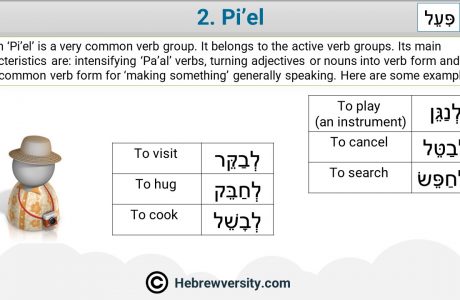
The Meaning Of “Binyan Pi’el”

Binyan Pi’el is one of the major verb patterns in Hebrew. It typically expresses intensive, repetitive, or causative actions in
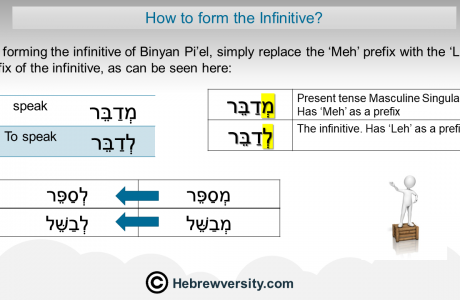
Binyan Pi’el Infinitive

Binyan Pi’el Infinitive

The infinitive form in Binyan Pi’el (פִּעֵל) is used to express the basic idea of an action – like “to
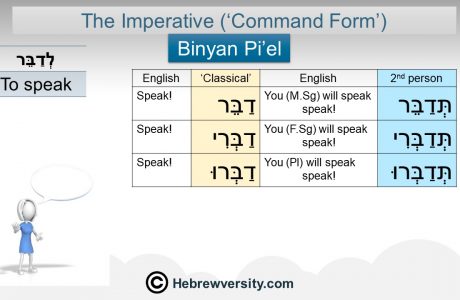
Binyan Pi’el Imperative

Binyan Pi’el Imperative

The imperative in Pi’el is used to give commands or requests in an emphatic or intensive tone. It’s typically directed
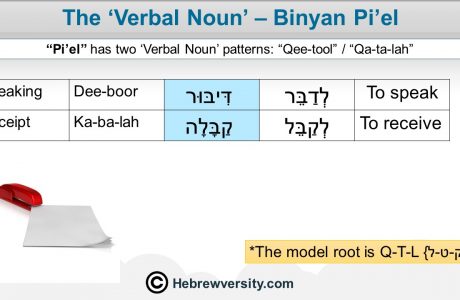
Binyan Pi’el Verbal Noun

Binyan Pi’el Verbal Noun

The verbal noun in Pi’el expresses the action itself as a noun – like “cooking,” “traveling,” or “telling.” It’s used
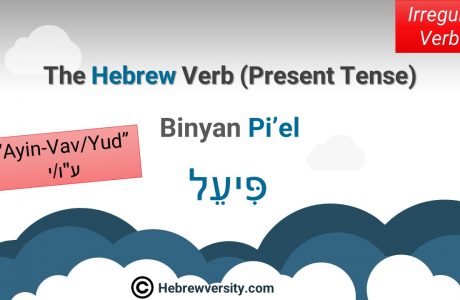
Binyan Pi’el: Present Tense – “Ayin-Vav/Yud”

Binyan Pi’el: Present Tense – “Ayin-Vav/Yud”

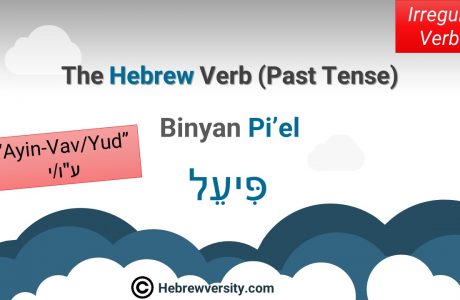
Binyan Pi’el: Past Tense – “Ayin-Vav/Yud”

Binyan Pi’el: Past Tense – “Ayin-Vav/Yud”

Binyan Pi’el: Future Tense – “Ayin-Vav/Yud”

Binyan Pi’el: Future Tense – “Ayin-Vav/Yud”

Binyan Pi’el: Present Tense – “Lamed-Heh”

Binyan Pi’el: Present Tense – “Lamed-Heh”

Binyan Pi’el: Past Tense – “Lamed-Heh”

Binyan Pi’el: Past Tense – “Lamed-Heh”

Binyan Pi’el: Future Tense – “Lamed-Heh”

Binyan Pi’el: Future Tense – “Lamed-Heh”

demov1

demov1

Contact us

Monthly Membership ($12)

Learning a new language means learning and understanding a whole new culture. Hebrew is not simply a language but rather a whole culture. To fully understand this magnificent language, one should learn more about its unique history, philosophy, literature and heritage.  For only $12 a month you can gain exclusive access to an absolute treasure trove of high-quality content.
Get Started
How to become a member?
Social networks
  • Facebook
  • Twitter
  • YouTube
Hebrewversity
  • Home page
  • About
  • Hebrew Lessons
  • Biblical Hebrew and Hebrew Bible Studies Program
  • Liturgical Hebrew and Jewish Studies Program
  • Modern Hebrew and Israel Studies Program
  • Articles
  • FAQ
  • Hebrew Premium
  • Hebrew Study Materials and Learning Resources
  • Biblical Hebrew & The Hebrew Bible
  • Hebrew Culture, History and Heritage
  • Contact
Contact details

Email:
ariel@hebrewversity.com

Powered By adactive | Web Design By Siteos
© All right reserved
Scroll to top
Skip to content
Open toolbar Accessibility Tools

Accessibility Tools

  • Increase TextIncrease Text
  • Decrease TextDecrease Text
  • GrayscaleGrayscale
  • High ContrastHigh Contrast
  • Negative ContrastNegative Contrast
  • Light BackgroundLight Background
  • Links UnderlineLinks Underline
  • Readable FontReadable Font
  • Reset Reset